A Practical Setup Guide for 3la.ai.
Want your brand to be preferred and cited by ChatGPT, Perplexity and Google AI Overviews? This guide walks you through setting up 3la.ai in under an hour, so you can close visibility gaps, optimise your content and compete in AI search (GEO).

What is the Three-Layer Approach?
Digital visibility now depends on more than traditional search engines. The Three-Layer Approach, developed by Nettpilot AS, is a methodology that splits optimisation into three layers:
- Layer 1 (Human clarity): Readability, trust, engagement and immediate value for the reader.
- Layer 2 (Search visibility): Technical SEO, semantic structure, metadata and crawlability.
- Layer 3 (AI citation readiness): Making sure large language models (LLMs) can understand your content, trust it and actively cite it. Read more in our definition of L3 AI citation readiness.
Older SEO tools focus on traditional keyword optimisation (Layer 2). Newer AI monitoring tools track AI mentions. 3la.ai is a tool that helps you analyse, optimise and publish content across all three layers in a single workflow.
Phase 1: Account setup and domain monitoring
Step 1: Create your account
- Go to threelayerapproach.com (or 3la.ai).
- Click “Get Started” or “Try for free”.
- Sign up with your company email address so integration with your domains is straightforward.
- Verify your email and log in to the dashboard.
Step 2: Add and verify your domain
- Enter your main domain (e.g.
yourcompany.com) in the domain management field. - Add any subdomains you want to monitor.
- Verify ownership to unlock advanced tracking. You can do this in three ways:
- Add a DNS record (TXT record) with your domain registrar.
- Upload an HTML verification file to your root directory.
- Connect via Google Analytics or Google Search Console.
- Define your official brand names, spellings and aliases. This lets the AI engine recognise when your brand is mentioned, even without a direct link.
Phase 2: Define your monitoring strategy
Step 3: Add strategic prompts
Prompts are what drive your AI monitoring. You tell 3la.ai which questions your potential customers ask AI assistants.
- Recommendation: Start with 20–50 strategic prompts.
- Examples of good prompts:
- “What are the best [service] providers in [city/region]?”
- “Which tools are recommended for [specific problem]?”
- “How do I choose the right supplier of [product category]?”
- “Who are the leading experts in [field] in [country]?”
- Strategic tip: Include prompts in every language your customers use, to cover multilingual search behaviour. Also include questions that name your biggest competitors, so you can benchmark against them.
Step 4: Choose which AI engines to track
Choose which generative engines 3la.ai should monitor for you. We recommend starting with the most widely used platforms. I am not oing to namedrop versions and models as the change very often. We usually add the newest flagship models within a few weeks and make sure we have the most popular and widespread versions available:
- ChatGPT: The largest engine for direct user questions.
- Perplexity: The leading AI search engine for real-time search.
- Google AI Overviews: Critical for keeping traditional organic visibility in Google.
- Gemini & Claude: Important engines for both consumers and developers.
- Mistral: : Since Mistral Large is heavily utilized in enterprise environments and search systems, including it ensures your web content is properly structured for Mistral to lift and cite your data verbatim.
Phase 3: Run your first 3LA analysis
Step 5: Run a 3LA analysis on your most important pages
Before you write new content, find out where your existing content falls short.
[ Paste URL ] ──> [ 3LA Engine ] ──> Analysis of L1, L2, and L3 Scores
- Open the analysis tool in https://3la.ai.
- Paste the URL of one of your key landing pages. Start with your five most-visited pages.
- Click “Run Audit”.
- After 30–45 seconds you get a full health check of the page.
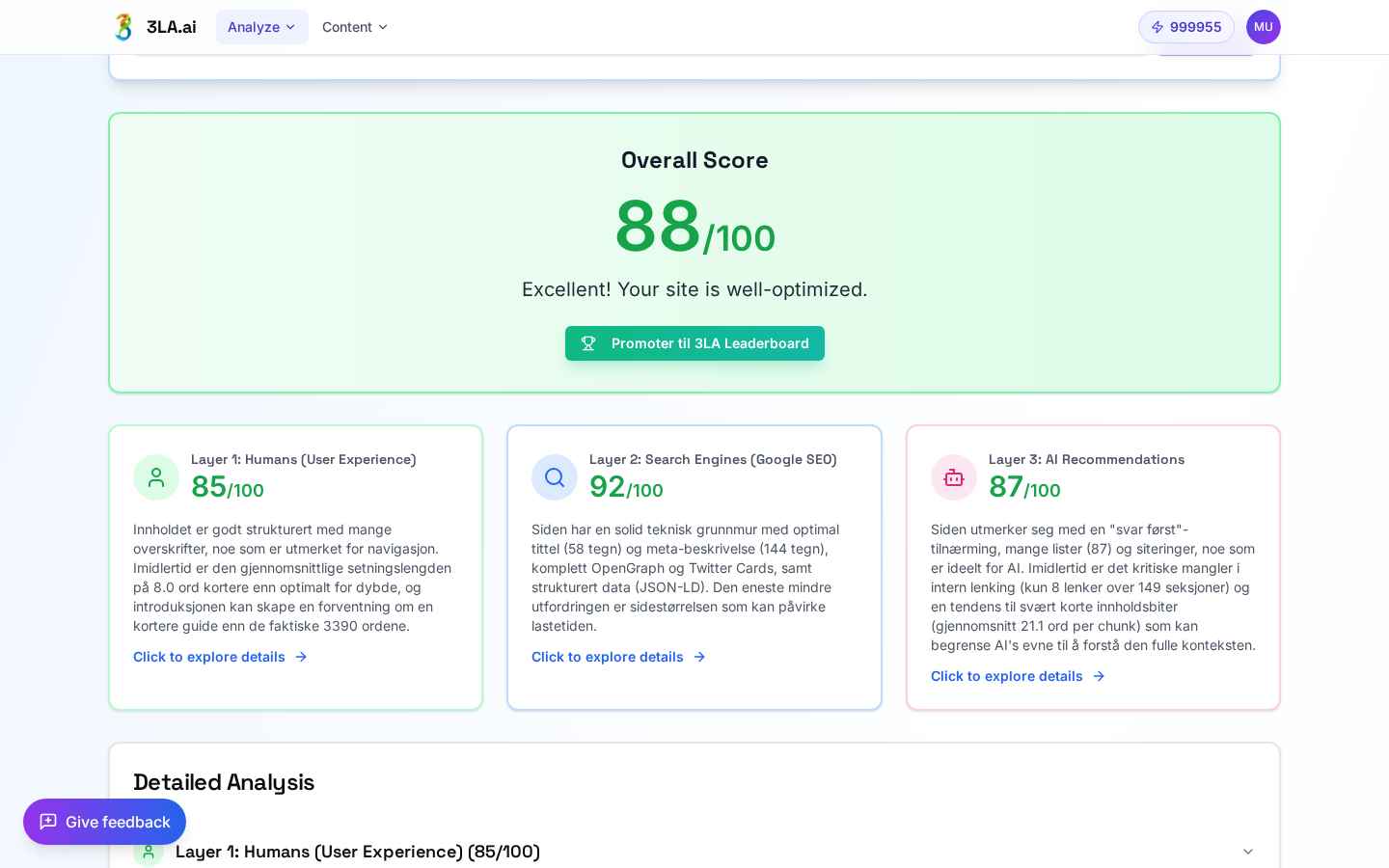
Step 6: Review your results
The report gives an overall score from 1 to 100, broken down by layer. Look especially for:
- Low L2 scores: Technical SEO gaps, weak heading structure or missing metadata.
- Low L3 scores: Content that is too vague or unstructured for AI models to extract as a reliable source.
- Robots blocks: Check whether your technical settings, or a missing or unoptimised llms.txt file, prevent AI crawlers from reading your content.
Phase 4: Optimise content for people, search and AI
Step 7: Use the 3LA Content Optimizer
Once you have found a page’s weak points, use the built-in AI assistant (Ulf or Pippa) to fix them.
- Copy the text from your existing page and paste it into the 3LA Content Optimizer.
- Choose your tone and target audience.
- Click “Optimize”.
Within seconds the system restructures your content by:
- Writing a strong BLUF introduction that answers both the reader’s and the AI engine’s question up front.
- Cleaning up the heading structure (H1, H2, H3) in line with semantic best practice.
- Generating precise, citable definitions and fact boxes that increase your citation rate.
- Producing ready-to-use JSON-LD schema markup that defines your brand entities for search engines.
Step 8: Publish directly to your CMS
- With 3LA Connector (WordPress): If you use our WordPress plugin, click “Publish via Connector”. The content, including JSON-LD and metadata, is updated on your site without touching code.
- Manual setup: Copy the optimised text into your usual editor and paste the generated JSON-LD into the page’s header field.
Phase 5: Measurement, insight and continuous improvement
Step 9: Connect Search Insights and Bing data
To get a full picture of your performance in AI search, connect your data sources:
- Open Search Insights in the dashboard.
- Upload or connect your performance data from Bing Webmaster Tools, which currently gives the most accurate view of AI search in Copilot.
- Connect Google Search Console to compare traditional organic click trends with your AI citation patterns.
Step 10: Find your “dark opportunities”
The dashboard shows a report of your biggest untapped opportunities.
- What is a dark opportunity? A page with high impressions in traditional search but a low citation rate in AI search.
- Action: Prioritise these pages for another round in the 3LA Content Optimizer. Making your claims more precise and authoritative can tip AI engines towards using you as a primary source.
Timeline and expected results
| Phase | Time | Outcome |
|---|---|---|
| Phase 1: Setup | 15 minutes | Your account is active and your domain verified and ready for tracking. |
| Phase 2: Monitoring | 30 minutes | Your key prompts and AI engines are configured. |
| Phase 3: First analysis | 60 minutes | You have a clear baseline score for your five most important pages. |
| Phase 4: Optimisation | 2–4 hours | Your first pages are optimised for all three layers and published. |
| Phase 5: Measurement | Ongoing | Expect the first changes in AI citation rate within 2–4 weeks. |
Avoid common setup mistakes
- Too few or too broad prompts: If you only track “What is SEO?”, the noise will bury the signal. Make your prompts specific and localised to the market you actually serve.
- Ignoring local languages: Many teams only set up English prompts. People search in their own language, and AI models answer differently across languages.
- Skipping structured data: If you skip JSON-LD generation in Layer 2, you make it needlessly hard for AI crawlers to connect your content to your brand.
- Ignoring the lowest scores: Pages scoring below 50/100 drag down your domain’s overall authority. Lift the weakest pages first.
Ready to take control of your AI visibility? Run a free analysis of your domain at 3la.ai today, or contact Nettpilot AS for a strategic review of your GEO strategy.
Related articles

3LA Content Optimizer vs. the alternatives
Why one additional layer separates content optimisation from AI citability - and what every major competitor is missing.
4 min