Why we rebuilt the 3LA audit: Honest numbers and page-aware scoring.
A review of one audit report found four figures that did not hold up. We traced each one to the code, fixed it, and changed how the audit judges a page: by what kind of page it is. The growing amount of AI-slop is why 3LA now focus on precision even more.

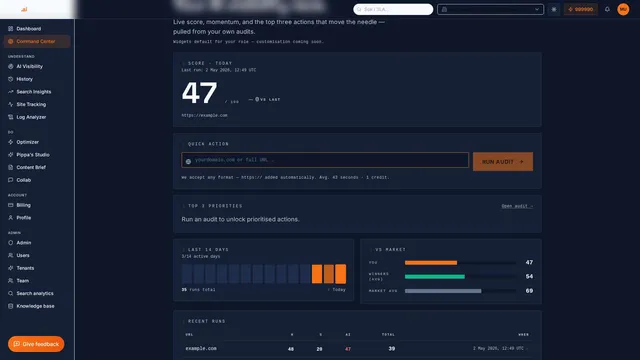
In October 2026 a reviewer went through a single 3LA audit report line by line. Four figures in it did not hold up. We traced each one to the code, fixed it, and used the review to change how the audit judges a page. The result is 3LA audit version 5.1, released on 29 October 2026.
This post explains what was wrong, why we changed what we changed, and what it means for the scores you see.
If you only read one thing: new audits may score differently from older ones because the method has changed, not because your page has. Older audits keep their original score and are labelled “Older method”. To compare, run the page again.
What the review found
The report was for the website of a Norwegian building contractor. The reviewer’s point was simple: a tool that tells customers what is wrong with their pages has to be right about its own numbers first.
| Finding in the report | Cause | Fix in v5.1 |
|---|---|---|
| 82.7 words per sentence | Text from neighbouring HTML elements was joined without a space (“Vestfold.We have”), so several sentences were counted as one. | Text is read with spacing between elements, and menus, headers and footers are left out. |
| 193 internal links, 9 sections, 38.6 links per section | The count included menu, footer and duplicate links. The density was divided by 5 paragraphs while the report said 9. 193 ÷ 5 = 38.6. | Only unique links in the main content are counted, and the report uses the same number of sections as the calculation. |
| Structural Proof Gap 80 % next to “SPG 20/100” | Both numbers were correct, but one was the gap and the other the coverage, under the same name. | The two are named separately: gap (higher is worse) and coverage (higher is better). |
| “40 % easier scanning”, “3× more likely to be cited” | These percentages came from example text in the instructions given to the AI model. No measurement supported them. | Removed at the source, and a filter strips any such figure the model still writes. |
Source: 3LA audit engine changelog v5.1.0, 29 October 2026.
None of these errors changed what was on the contractor’s page. They changed what we said about it. That is the more serious kind of error for an audit tool.
Why a made-up percentage is worse than no number
Decision makers need to know what a change is likely to achieve. “Add structured data” is not enough to prioritise against ten other tasks. That need is real, and it is why the AI model was writing percentages in the first place.
A percentage without data behind it is still invented. When a reader checks one such figure and finds nothing behind it, they stop trusting the rest of the report, including the parts that are correct.
So every recommendation now carries a structured estimate instead of a number:
| Field | What it says | Example |
|---|---|---|
| Effect | Low, medium or high | Medium |
| Affects | Which layer and metric | L3, Structural Proof Gap |
| Basis | What we observed on the page | Prices appear in the text but not in structured data |
| Measured with | How you check the result afterwards | Schema coverage in the next audit, AI citations in Search Insights |
A number is only used when it is calculated from data we hold, for example how schema coverage would change if two missing claims were marked up. That is a calculation, not a promise.
One ruler for every page was the wrong ruler
The same review raised a second, deeper problem. The audit judged every page by the same thresholds.
The contractor’s page had 81 images on 983 words. The old audit marked that down as a poor image-to-text ratio. For a building contractor, project photos are the evidence a customer wants to see. A product page was marked down for having no author or publication date, which a product page does not need.
The audit now identifies the page before it judges it, on two separate axes:
- Form: what the page is. 17 types, including homepage, service page, product page, category, article, research, documentation and contact page.
- Intent: what the page is for. Inform, evaluate, convert or navigate. A blog post written to sell is an article with the intent to convert, not a separate page type.
The page type is decided by weighted evidence: structured data, the classes your CMS adds to the page, Open Graph tags, the page’s own content and its URL. The report shows which evidence was used. A URL containing /blog/ no longer outweighs structured data that says the page is a product.
Metrics that do not apply to a page type are shown as “not applicable” and are left out of the score entirely. They are not counted as passed, and they are not counted as failed. The same goes for the Structural Proof Gap: claim types that do not fit the page type, such as author on a product page, are left out of the calculation.
If the audit gets the page type wrong, you can correct it, or run the audit again as the right type. The original audit stays as it was.
All three layers now combine measurement and judgement
Until version 5.1, only the AI layer (L3) combined measured metrics with the AI model’s assessment. The human layer (L1) and the search layer (L2) were the AI model’s own score. That had a side effect we did not like: no change in measurement or page type could move those two layers.
All three layers are now 50 % measured metrics and 50 % AI assessment. The overall score is still weighted 30 % human, 40 % search and 30 % AI, and that weighting now applies everywhere in the platform.
What this means for your scores
Every audit now records the version of the method it was scored with. That changes how scores should be read:
- Compare within a version. An older audit and a new one were measured with different rulers. A difference between them is not, by itself, progress or decline.
- Older audits are not recalculated. We considered recalculating them automatically and decided against it: the stored figures came from the old counting, and relabelling them as new would hide that.
- Improvement over time is only calculated between audits of the same page type.
- The leaderboard gets a separate list per page type, shown once a page type has at least 30 audits on the new method.
What we have not proven yet
The thresholds for each page type are professional judgement, not yet measurement. We will check them against the data in Search Insights: whether pages that score higher under the new method are also cited more often by AI systems relative to their search impressions. We will publish what we find, including if it shows we need to adjust.
We are applying the same standard to our own website. Figures we could not document have been removed from the homepage, the GEO guides and the glossary, and we are reviewing the rest.
Frequently asked questions
Why did my score change? The method has changed. Metrics that do not apply to your page type no longer count, counting errors are fixed, and all three layers now include measured metrics. Run the page again to get a score you can compare with future audits.
Is my old score wrong? It was measured with the previous method, which had the counting errors described above. It is kept as it was and labelled “Older method”, so your history stays intact.
What if the audit picks the wrong page type? Correct it in the report, or choose “Run again as [type]”. That runs a new audit with the page type you choose and uses one credit.
Does the audit now give estimates of impact? Yes, as low, medium or high, with what it affects, what it is based on and how to measure it. It no longer gives percentages that are not backed by data.
Run a new audit from your dashboard to see your pages measured with version 5.1. New to 3LA? Sign up here.
Related articles
BrightonSEO: Why classical SEO is no longer enough for modern discovery
Discover how BrightonSEO validated the Three-Layer Approach. Learn how to optimize content across human, search, and AI channels for maximum citations.
5 min
BrightonSEO 2026 Just Validated the Three-Layer Approach
BrightonSEO's 10th anniversary edition, held October 8–9, 2026 and drawing roughly 4,500 attendees, was dominated by one theme: GEO (Generative Engine Optimization), AI citations, and agentic recommendations. For anyone building on the Three-Layer Approach, this wasn't new information - it was confirmation.
2 min