Your SEO Audit has a missing Layer.
Most audits cover two layers. The one they skip is where AI visibility is decided.
In March 2026, three separate research reports landed within days of each other. Define Media Group published data showing organic search clicks had fallen 42% since Google AI Overviews launched — a decline that started immediately and never recovered. Jay Stampfl wrote in Search Engine Land that Google Ads now redistributes advertiser value across weaker inventory in ways that are structurally invisible to standard reporting. Will Scott showed how to build a custom SEO intelligence stack using Claude Code and Python — and in the same article acknowledged that AI citation tracking remains “wind sock, not GPS.”
Three different angles. One shared conclusion: the measurement frameworks most practitioners rely on were built for a search environment that no longer exists.
This article introduces the Three-Layer Approach (3LA) — a diagnostic framework for understanding why your site ranks in search but disappears in AI-generated responses — and proposes a more complete audit model for 2026.
The standard audit covers two layers
A competent SEO audit in 2026 typically covers:
Layer 1 — Human readability. Does a person find this page credible and useful? This is the domain of UX, trust signals, conversion rate optimisation, and content quality. Tools: Hotjar, GA4, heatmaps.
Layer 2 — Search engine readability. Does a crawler correctly index and rank this page? This covers crawlability, Core Web Vitals, schema markup, backlink authority, and keyword relevance. Tools: Screaming Frog, Ahrefs, Google Search Console.
These two layers are well-understood. Every serious agency has a framework for them. The checklists are long. The tooling is mature.
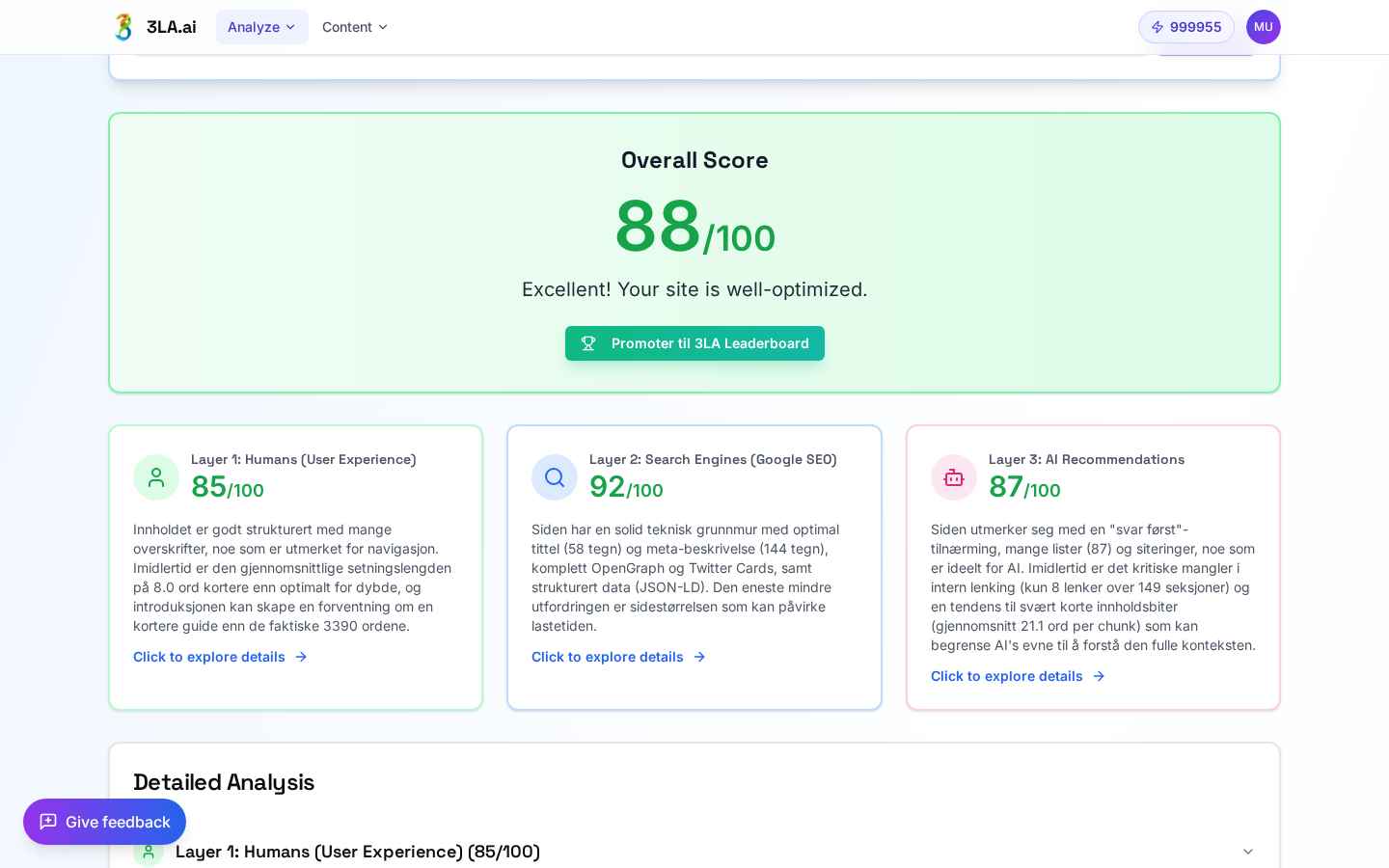
And yet: a site can pass both layers with flying colours and still be completely absent from AI-generated responses. The question no standard audit asks is a third one entirely.
Layer 3 — AI inference readability. Does an AI system cite this domain when answering queries in its category?
This layer does not exist in any standard audit framework. It has different signals, different measurement tools, and a fundamentally different logic. Understanding why requires a brief detour into how inference differs from indexing.
Why ranking and citation are not the same thing
When a search engine ranks a page, it is answering a question about relevance: does this URL match this query? The process is comparative — your page competes against others for position.
When a large language model cites a source, it is answering a question about credibility: can I extract a verifiable claim from this domain and ground my response in it? The process is not comparative in the same way. It is evaluative. The LLM is asking whether your content constitutes a reliable, extractable fact about an entity or topic.
These are different problems with different solutions. A page optimised for keyword density and backlink authority may score poorly on the signals LLMs use to evaluate citation-worthiness: entity clarity, information gain, structured claims, and machine-readable context.
The result is what we call the Proof Gap — the measurable delta between your search visibility and your AI citation frequency. A site with high search visibility and low AI citation has a Proof Gap. It is the dominant condition for active SEO clients in 2026.
The Proof Gap Matrix
Mapping sites against two axes — search visibility and AI citation frequency — produces four quadrants:
Invisible (low rank, low citation): The baseline problem. Start with L1 and L2.
Traditional SEO Winner (high rank, low citation): The Proof Gap problem. Ranks well. Cited rarely or never. This is where most established sites with strong SEO programmes currently sit.
AI-only Visible (low rank, high citation): Rare. Typically brand authority without technical SEO investment. Fragile and difficult to sustain.
Full-spectrum Visible (high rank, high citation): The target state. Rankings and citations are complementary, not competing.
The 42% organic click decline documented by Define Media Group makes the upper-left quadrant — Traditional SEO Winner — increasingly untenable as a long-term position. High rankings without AI citation means high investment yielding diminishing returns as AI Overviews absorb an ever-larger share of query resolution.
What Layer 3 actually requires
Closing the Proof Gap is not a technical SEO problem. It requires a different set of interventions:
Entity disambiguation. LLMs need to know unambiguously who you are. “We help businesses grow online” is not entity-clear. “Nettpilot AS is a Norwegian digital agency specialising in GEO and technical SEO for Nordic e-commerce” is. The difference is the difference between being a background noise signal and being a citable entity.
llms.txt implementation. A machine-readable context file that explicitly defines your domain’s scope, primary entities, and citation-worthy claims. Where robots.txt tells crawlers what to index, llms.txt tells inference systems what to trust.
Information Gain content. Content that contains epistemic value an LLM cannot synthesise independently. The category includes: original audit data, proprietary methodologies, first-party research, and documented case studies with specific outcomes. If an AI can generate the same content from its training data, it has no reason to cite you. If it cannot, citation becomes a dependency.
JSON-LD for inference. Schema markup designed not just to satisfy Google’s structured data requirements, but to model entity relationships, expertise claims, and contextual signals that LLMs can extract and verify. The distinction matters: schema for ranking is about match quality. Schema for citation is about claim verifiability.
Citation Readiness: the metric that replaces rankings
We use the term Citation Readiness to describe a site’s structural preparedness to be cited by AI systems. It is not the same as being cited — that requires actual measurement against a defined query set, which is what Citation Rate tracks. Citation Readiness is the proxy: given what we can observe about a site’s entity clarity, content structure, and machine-readable signals, how likely is it to be cited?
The relationship between these two measures is straightforward. Citation Readiness is the input variable. Citation Rate is the output. A high Citation Readiness score does not guarantee citation — the competitive landscape, query intent, and LLM behaviour all play a role — but low Citation Readiness makes citation structurally unlikely regardless of search performance.
This is the metric that a complete audit must now include. Not instead of rankings and traffic. Alongside them.
The complete three-layer audit
A full visibility audit in 2026 runs five phases:
Phase 1 — L1 + L2 Baseline (Week 1). Standard technical SEO audit. Crawl, index, Core Web Vitals, schema, backlink profile. Most agencies deliver this well. It is the foundation, not the deliverable.
Phase 2 — Query Mapping (Week 1–2). Define the query universe: 50–200 intent-based queries your domain should appear in. Include informational, commercial, and conversational variants. This is the input set for the L3 audit.
Phase 3 — L3 Citation Audit (Week 2). Run each query across ChatGPT, Perplexity, and Google AI Overviews. Log who gets cited, in what context, and what entity signals appear to have triggered the citation. This is manual work. It is also the only way to establish a baseline.
Phase 4 — Gap Analysis (Week 3). Cross-reference L2 ranking data against L3 citation data. Calculate Citation Gap per query category. Identify Dark Opportunities — high-intent queries where AI answers without citing anyone in the niche.
Phase 5 — Prioritised Fixes (Week 4+). Implement Layer 3 interventions in priority order: entity disambiguation, llms.txt, Information Gain content, JSON-LD for inference. Measure Citation Rate before and after. The KPI is not rankings. It is citation frequency.
Why this matters now
The standard objection to GEO and AI-visibility work is that the causal chain between citations and business outcomes is not yet fully documented. That is a fair observation. The measurement infrastructure is immature. Will Scott is right that AI citation tracking is currently directional rather than precise.
But the 42% organic click decline is not directional. It is a documented, irreversible structural shift in how search traffic distributes. That traffic went somewhere. Some of it went to direct answers that required no click. Some of it went to the domains being cited in those answers.
The businesses currently capturing AI-mediated discovery share are not doing so by accident. They have entity clarity. They have original data. They have machine-readable context. They built what an LLM needs to ground a response.
That is the Proof Gap, closed.
The Three-Layer Approach (3LA) is a proprietary framework developed by Nickolass Jensen at Nettpilot AS. The AI Reality Audit, Citation Tracker, and Query Library are available via the 3la.ai platform.
Related articles

Your GEO Strategy Is Failing Three Out of Four AI Audiences
ChatGPT, Claude, Perplexity and Gemini do not share a user base. They share a category name. A 2026 study found only ~11% of domains cited by ChatGPT are also cited by Perplexity. Here is the field guide to a platform-segmented GEO strategy.
15 min