Your GEO Strategy Is Failing Three Out of Four AI Audiences.
ChatGPT, Claude, Perplexity and Gemini do not share a user base. They share a category name. A 2026 study found only ~11% of domains cited by ChatGPT are also cited by Perplexity. Here is the field guide to a platform-segmented GEO strategy.

Your GEO Strategy Is Failing Three Out of Four AI Audiences
By Nickolass Jensen, Founder & CEO, Nettpilot AS
I recently recorded an episode of SEO in 2026: Additional Insights with David Bain. We were supposed to talk for fifteen minutes. Two and a half hours later, we were still going.
One idea kept pulling us back: most SEOs and marketers talk about "AI search" as if it were a single channel. One audience. One optimization target. One set of rules.
It isn't.
ChatGPT, Claude, Perplexity, and Gemini do not share a user base. They share a category name. And that distinction - which sounds academic until you look at the data - changes everything about how you should be approaching Generative Engine Optimization in 2026.
This is the article I wish existed before that conversation. It is the full version of what I could only sketch in the recording.
The number that reframes everything
A 2026 cross-platform citation study by Whitehat SEO covering 118,000 AI-generated answers found that only about 11% of domains cited by ChatGPT are also cited by Perplexity - and that 71% of all cited sources appeared on only one platform. A separate analysis by AuthorityTech across 680 million AI citations reached the same conclusion: universal citation visibility is rare. Ziptie.dev's structural comparison of how different AI platforms cite the same source found material differences in which domains each engine trusts, even for identical queries.
Read that again: roughly 9 out of 10 domains that Perplexity cites in its answers are invisible in ChatGPT's responses to the same queries - and vice versa.
If your GEO strategy is built around one engine, you are structurally invisible to the users of the other three. Not because your content is bad. Because you are optimizing for the wrong audience.
The brands winning in AI search right now are not the ones working hardest. They are the ones who matched their content to the cohort that actually uses their preferred platform.
Here is what that means in practice, platform by platform.
ChatGPT: the default for people who are not thinking about which AI to use
Scale: ~800-900 million weekly active users. Over 2.5 billion prompts per day (TechCrunch, July 2025). Despite losing market share - down from around 87% in early 2025 to roughly 68% in early 2026 (First Page Sage, April 2026) - ChatGPT remains the gravitational center of the category by a wide margin.
Who uses it: Behavioral overlap data from Similarweb places ChatGPT users alongside Google, YouTube, and Instagram. The dominant age cohort is 25-34, followed by 18-24. Together, under-35s account for roughly 60% of users. Interest categories lean toward entertainment, gaming, streaming, and general productivity.
This is the platform people use when they are not choosing a platform. ChatGPT is the default - the name everyone knows, the tab everyone already has open.
What this means for your GEO strategy: If your product targets consumers making moderate-consideration purchases - travel, retail, food, health, general services - ChatGPT is your primary citation target. The user is looking for a shortlist or a recommendation, not a literature review.
Content that performs here is structured, directly answerable, and built from Atomic Content Units (ACUs) - the smallest self-contained units of verified information that each fully resolve a single user intent. Think of an ACU as an atomic truth block: a discrete, citable statement that an AI model can lift into an answer without needing to interpret the surrounding text. When your pages are assembled from clearly defined ACUs rather than undifferentiated long-form prose, ChatGPT can extract and reuse exactly the part of your content you want to be known for. Entity recognition and consistent brand signals matter here - but they are downstream of having clean, well-named content units in the first place.
Claude: the platform for people who have already made a deliberate choice
Scale: Roughly 20-30 million monthly active users (Siteline, mid-2025) - a fraction of ChatGPT's consumer reach. The headline number is deeply misleading. Claude's enterprise revenue reportedly surpassed OpenAI's enterprise revenue in mid-2025, despite the consumer gap. These are not the same market.
Who uses it: Audience overlap data shows Claude users clustering around GitHub, Stack Overflow, Notion, and Figma. Programming and technology are the top interest categories. Claude powers Cursor, Windsurf, and Claude Code - it is the backbone of the developer tooling ecosystem. It is also disproportionately used in regulated industries: legal, financial services, healthcare, and compliance-heavy environments where accuracy and nuance matter more than speed.
The critical insight here is behavioral. People who use Claude are not "trying an AI toy." They have evaluated the options and made a deliberate tooling choice. They expect the tool - and by extension, the sources it cites - to be precise, verifiable, and technically sound.
What this means for your GEO strategy: If your buyers are developers, technical decision-makers, or knowledge workers in regulated industries, Claude is disproportionately important relative to its consumer market share. Vague brand claims will not be cited. Generic "ultimate guide" content will not be cited. Specific, verifiable statements backed by structured data and explicit sourcing will be.
For this cohort, we also recommend building an llms.txt file - a Markdown-based, machine-readable knowledge index that functions like a robots.txt for LLMs. It tells AI crawlers where your most authoritative content lives, which datasets and reports represent your definitive position on a topic, and under what terms that content can be used. For teams already maintaining API documentation or Markdown-based knowledge bases, llms.txt is a natural extension of existing practice.
Perplexity: where high-consideration buyers go to verify
Scale: Around 20-25 million monthly active users (AI Business Weekly, 2026). The smallest of the four by raw numbers. Also the most underestimated in terms of citation value.
Who uses it: Behavioral overlap data shows strong affinity with Google Docs and Calendar - tools associated with structured professional work. Perplexity's user base skews toward highly educated knowledge workers, analysts, consultants, academics, and researchers. These users do not ask AI for a quick answer. They use it to stress-test what they already think they know.
Perplexity functions as a search engine replacement, not a chatbot. Users arrive with a specific question and expect a sourced answer with clickable references they can verify.
What this means for your GEO strategy: A citation in Perplexity carries disproportionate commercial weight for high-consideration B2B purchases - consulting, legal, financial services, pharma, enterprise software, complex B2B SaaS. If your buyers research extensively before buying, Perplexity visibility may be more commercially valuable than ChatGPT visibility despite the raw traffic difference.
Content that performs here must be genuinely citation-worthy: primary data, original research, narrow claims backed by explicit evidence. Perplexity does not reward thin content dressed up with clean structure. It rewards substantive content even when the structure is imperfect. ACUs with explicit references, tables, datasets, and tight conclusions perform significantly better than well-formatted opinion pieces.
Gemini: the one your audience is probably already using without knowing it
Scale: Multiple estimates suggest Gemini reached 700-750 million monthly active users by early 2026, up from a low single-digit share of AI-assistant traffic just twelve months earlier (Statcounter; LinkedIn market share analysis, January 2026). Gemini surpassed 2 billion monthly website visits in January 2026. This is the fastest growth story in the AI space for 2025 - driven almost entirely by distribution, not by users actively choosing the product.
Who uses it: Roughly 75% of Gemini interactions happen on mobile, reflecting its Android ecosystem advantage. Google has embedded Gemini into Search, Gmail, Google Photos, Docs, and Android - hundreds of millions of people encounter it not by choosing it, but because they already live inside Google's product ecosystem.
Gemini's referral traffic to external websites grew several hundred percent year-over-year, significantly outpacing ChatGPT's growth rate (Siteline, mid-2025). That implies Gemini is already functioning as a genuine discovery engine, not just an on-page answer layer.
Critically, Gemini shares core models with Google's AI Overviews and AI Mode. Optimization that helps you appear in Gemini answers compounds into broader Google Search AI feature visibility (SEMrush AI Mode comparison study, 2026).
What this means for your GEO strategy: For businesses targeting SMBs, local markets, or audiences embedded in Google's product suite, Gemini is the highest-leverage platform. The structured content signals that have always mattered for Google - E-E-A-T, schema markup, authoritative backlinks, topical depth - translate directly into Gemini citation visibility.
A practical example: our article The Complete Business Guide to Google Gemini on nettpilot.com was updated with 3LA Layer 3 principles alongside the publication of a new 2026 guide - and the citation results were measurable within weeks. The full story is in the next section.
The Dark Opportunity problem - and what it reveals about most sites
Before we get to the case data, it is worth naming the structural problem precisely.
A Dark Opportunity is a page with meaningful impressions in Google Search Console - thousands of potential exposures - that never appears in ChatGPT, Perplexity, Gemini AI Overviews, or other AI answer interfaces. The page is findable to humans via traditional search. It is effectively invisible to AI.
Dark Opportunities are not rare. In our work across client sites, they are the norm. Most pages that rank in traditional search have not been optimized for AI citation. They contain claims but no verifiable evidence. They have structure but no machine-readable proof. They are human-readable but not LLM-extractable.
This is what we call the Hidden Content Paradox: your content exists, it ranks, people can find it - but AI systems pass over it because they cannot extract a citable unit of information from it with confidence.
Dark Opportunities are also the fastest wins available once you have the right diagnostic. A page that already has search authority (L2) and trust signals (L1) but lacks machine-readable proof (L3) can move from zero AI citations to consistent citation traction with targeted L3 work alone. You do not need to rebuild from scratch. You need the right diagnosis first.
What actually happened when we applied this to a new domain
nettpilot.com is not an established authority site. It launched with almost no backlink profile and a minimal search footprint.
By the logic of classical SEO, a domain at this stage should not be generating meaningful citation traction anywhere. You need authority. Authority takes time. That is the sequence.
Here is what actually happened.
The Complete Business Guide to Google Gemini - an existing page updated with 3LA Layer 3 principles on April 6, 2026, at the same time as a new 2026 Gemini guide was published - then accumulated 326 documented AI citations within two days, documented via Bing AI Performance Report. That is 75.8% of every AI citation the domain has ever received, concentrated on one page, on a domain that barely exists in traditional search terms. Not by changing the content at any meaningful scale, but by re-structuring it.
Monthly citation volume grew from 32 in January 2026 to 1,048 in April 2026. That is a 3,275% increase in three months.
The Citation Frequency Rate (CFR = AI Citations / Search Impressions × 100) for that page is 2.57%. It has reached 62,012 views and holds first-page positions in both Bing and Google Search. It is cited 799 times across the Bing / ChatGPT / Copilot system, against only 14 traditional-search clicks - meaning it is cited in AI systems at least 61.5× more often than it is clicked in search. That number is structurally impossible in a PageRank-only world. We have also documented several visible citations in Google AI Overviews.
It is worth being precise about what drove this growth, because the mechanism matters.
The citation spike coincided with two simultaneous actions: the publication of a new, standalone 2026 Gemini guide built with 3LA principles from the ground up, and a targeted L3 update to the existing 2025 guide - adding structured data, tightening ACUs, and making implicit claims explicitly verifiable.
Both pages saw citation lift. The new guide performed as expected: fresh, L3-optimised content attracting AI crawlers from day one. But the updated 2025 guide is the more instructive result. That page already had search authority (L2) and established trust signals (L1). It was not broken. It was simply invisible to AI systems because it lacked machine-readable proof at Layer 3.
One targeted update changed that. No rebuild. No new backlinks. No domain authority shift.
That is the Dark Opportunity mechanism in practice: a page that ranks, that humans find, that AI systems consistently pass over - until the L3 gap is closed. The diagnosis preceded the fix, and the fix was surgical.
What made it work was not domain authority. It was Layer 3 - machine-readable proof, Atomic Content Units, explicit sourcing, structured data that AI crawlers can extract and reproduce without interpreting surrounding context.
The implication for your strategy: waiting for domain authority before investing in AI visibility is the wrong sequence. The citation gap is closeable from day one. And for pages you already have - pages sitting on adequate L1 and L2 foundations - it may be closeable faster than you think.
The three-layer diagnostic: why most GEO advice misses the point
The most common failure in GEO is fixing the wrong layer. Here is what each layer actually means and why the sequence matters.
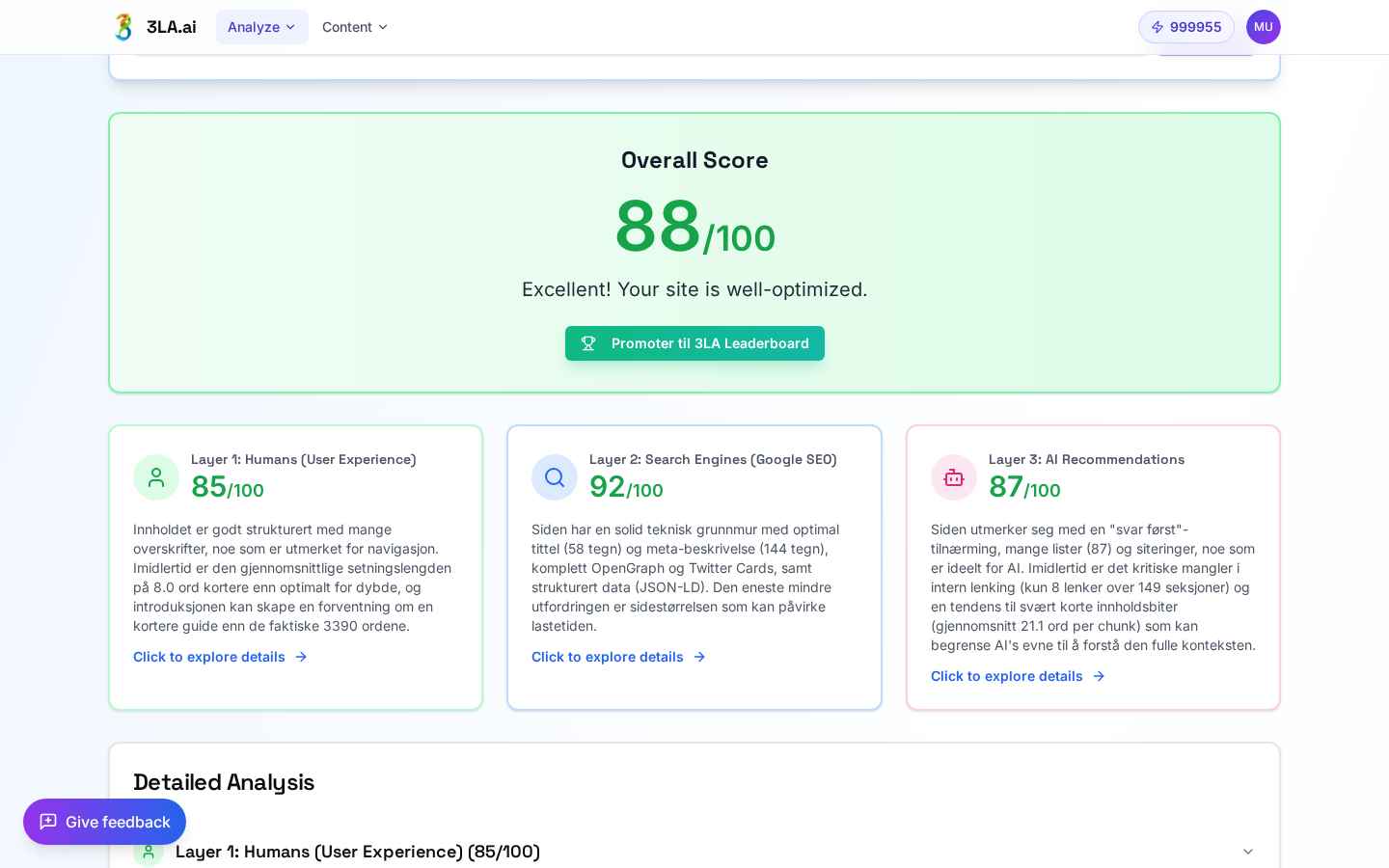
Layer 1 - Human/UX: Does the page look trustworthy to a human? Missing authorship, unclear credentials, no methodology disclosure, generic copy - these are L1 problems. AI models, especially Claude and Perplexity, are trained to evaluate source credibility. A page a human would not trust is a page an LLM will not cite.
Layer 2 - Search/SEO: Does the page have the structural authority signals that AI systems inherit from the web? Multiple studies show that AI answers heavily overlap with Google's top organic results (SEMrush; SE Ranking, 2026). Weak internal linking, shallow topical depth, and a thin backlink profile suppress citation likelihood even when the content is good.
Layer 3 - AI/GEO: Does the page present its claims in a form AI systems can extract, compare, and reproduce? The absence of structured markup, explicit references, datasets, tables, and Atomic Content Units makes a page harder to cite even when the underlying information is strong. ACUs are what AI systems lift into answers. If you do not design them, the model synthesizes something approximate - and you lose attribution.
The sequence is fixed: fix L1 before L2, fix L2 before L3. L3 optimization on an L1-deficient page produces no citation lift. A technically pristine, well-linked page that makes vague claims will not be cited. The diagnosis has to precede the fix.
Dark Opportunities - pages with high GSC impressions and zero AI citations - are almost always an L3 problem sitting on top of adequate L1 and L2 foundations. They are the fastest wins available once you have the diagnostic framework in place.
The five-step operating model
-
Match your ICP to the primary platform. Consumer product, under-35 audience → ChatGPT. Developer tool or enterprise software → Claude. High-consideration B2B, research-led buyers → Perplexity. SMB, local market, Google-ecosystem audience → Gemini. Start where your buyers actually ask questions.
-
Audit citation visibility per platform. Run your core commercial queries in each engine. Document whether you appear as a cited source. This is your baseline. A rise in ChatGPT citations tells you nothing about Perplexity or Gemini.
-
Check your server logs. GPTBot, ClaudeBot, and PerplexityBot crawl differently - different frequencies, different content preferences, different fetch patterns. Most site owners have never looked at these logs. Cross-reference AI crawler activity with GSC impressions. The gap between what crawlers index and what gets cited is your Dark Opportunity map.
-
Fix in sequence: L1, L2, L3. Trust signals first. Authority signals second. Machine-readable proof third.
-
Track CFR per platform. Citation Frequency Rate (CFR = AI Citations / Search Impressions × 100) is the KPI that most SEO tools do not yet measure natively. Build the habit of tracking it manually until the ecosystem catches up. Measure per page, per platform.
One thing I said to David that I want to put on record
GEO in 2026 is still mostly theoretical for most practitioners. The frameworks exist. The data is accumulating. But the tooling that enforces structured execution at scale is still early.
That is not a reason to wait. It is a reason to start building the measurement infrastructure now, while the channel is still underpriced relative to its commercial importance.
We are moving from an information economy to an inference economy - from a world where users perform the synthesis to one where the machine does. When ChatGPT, Claude, Perplexity, and Gemini decide which sources to cite in their answers, your job is to build content infrastructure that makes it structurally difficult for them to ignore you.
Rankings remain infrastructure. But the real competitive moat in 2026 is whether an LLM cites you when a buyer asks - and whether you have matched your content to the cohort of that buyer's preferred platform.
Go deeper
The research behind this article - including full citation data, platform cohort analysis, and the complete Three-Layer Diagnostic methodology - is documented in the companion whitepaper:
GEO in 2026: Why a Platform-Segmented Strategy Beats "AI Search" as a Single Channel
Download the whitepaper → (email required - no spam, one document)
Three ways to act on this today
Try the platform free See your own Dark Opportunities, track CFR per platform, and run your first three-layer diagnostic - no commitment required. Start your free trial at threelayerapproach.com →
Book a 3LA Audit A structured diagnostic session that maps your AI citation visibility across all four platforms, identifies which layer is failing on your highest-value pages, and produces a prioritized fix sequence you can act on immediately. Book a 3LA Audit at threelayerapproach.com →
Nickolass Jensen is the founder and CEO of Nettpilot AS, a Norwegian digital agency specialising in technical SEO, GEO, and WooCommerce development. He is the creator of the Three-Layer Approach™ (3LA) - a structured methodology for diagnosing and improving AI citation visibility.
Related articles
Your SEO Audit has a missing Layer
Most audits cover two layers. The one they skip is where AI visibility is decided.
7 min
Entity Accuracy Engine - Why we built it and who it's for
LLMs hallucinate about companies, prices, key people and mandates - and it's costing NGOs, universities, research bodies, financial institutions, political actors and agencies real leads and real trust. Here's the background of the Entity Accuracy Engine, and exactly who I built it for.
3 min