Frequently Asked Questions
What is the Three-Layer Approach (3LA)?
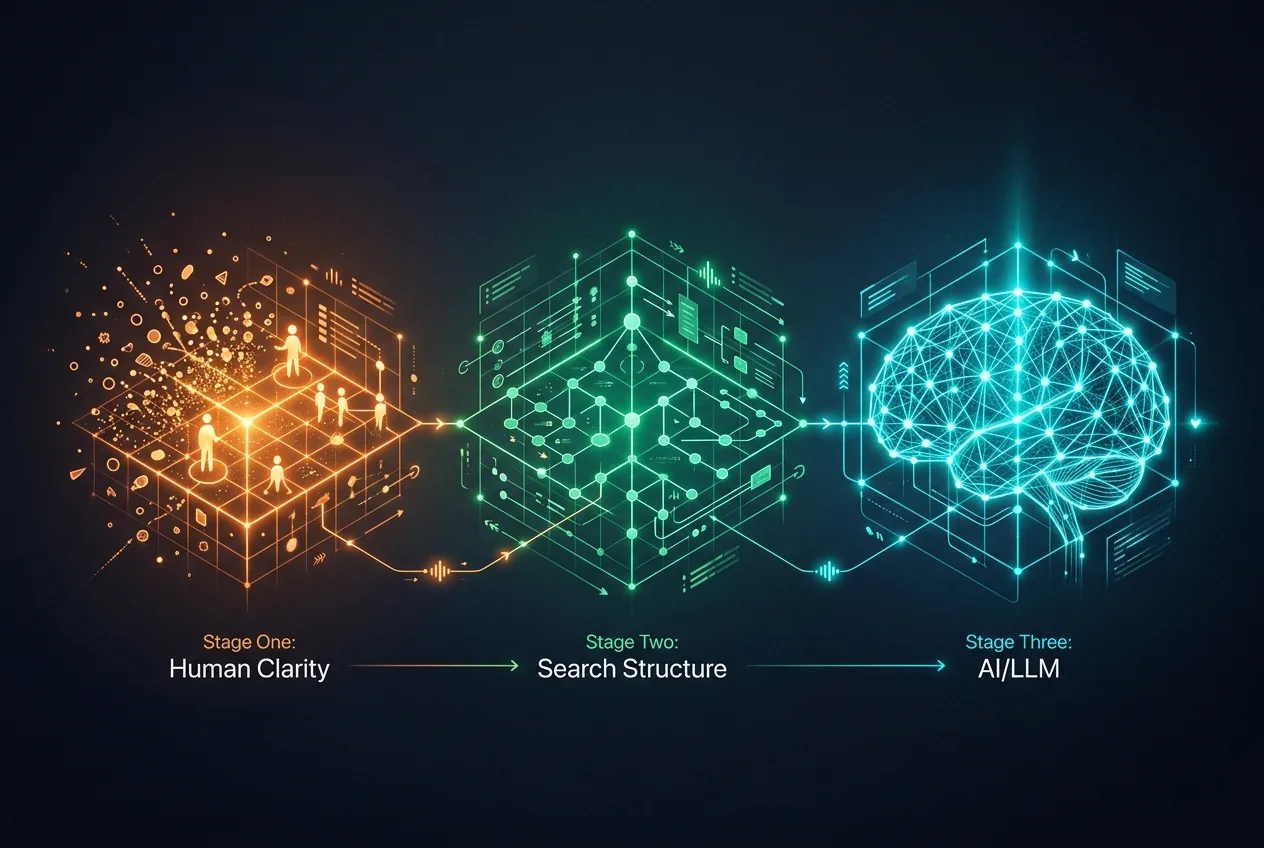
3LA is an AI visibility framework that scores every piece of web content on three layers: L1 Human (readability, trust signals, UX), L2 Search (technical SEO, structured data, Google ranking signals), and L3 AI/GEO (how often ChatGPT, Claude, Perplexity and Gemini cite your brand in answers). You get a single number out of 100 and concrete actions to lift it.
What is GEO?
GEO (Generative Engine Optimization) is the practice of structuring web content so AI models cite it verbatim inside generated answers, not just rank it in a list of blue links. Where SEO optimises for position in a SERP, GEO optimises for being the source of the answer itself.
What do L1, L2 and L3 actually mean?
L1 is what a human reader experiences: clarity, flow, one H1, short sentences, visible trust signals. L2 is what search crawlers see: title/meta, JSON-LD coverage, internal linking, canonicals. L3 is what AI models need to cite you: FAQPage schema that matches visible FAQ, atomic content units, a /llms.txt summary, explicit author and organisation. The 3LA score is the average of all three.
How is GEO different from SEO?
SEO optimises for ranking in a list of blue links. GEO (Generative Engine Optimization) optimises for being cited inside an AI-generated answer. The mechanics differ: AI models prefer structured chunks, clear Q&A format, strong trust signals, and citeable factual claims – not just keyword density and backlinks.
Which AI models do you test against?
It depends on the module. Every quick audit samples three models in parallel via our LLM gateway – OpenAI GPT-5.2, Anthropic Claude Sonnet 4.6 and Google Gemini 3.1 Pro – running 10-20 prompts scoped to your brand and sector, then aggregating mention rate, citation rank and sentiment into the L3 score. Brand Analyzer and Citation Tracker go further: they probe all five major LLMs, adding Perplexity (Sonar / Sonar Pro) and Mistral Large on top of GPT, Claude and Gemini, so you see cross-model visibility in one view.
Do I need technical skills to use 3LA?
No. Paste a URL and you get a full report with prioritised actions in ~45 seconds. For agencies and in-house teams we also offer direct WordPress/Webflow integration so the content brief can be published with one click.
What does the free trial include?
Three full audits, the Command Center dashboard, prompt tracking for one brand, and the Pippa AI content brief generator. No credit card required – you log in via a one-click magic link sent to your email.
What is the Structural Proof Gap (SPG)?
SPG measures the distance between what your page claims in text and what it proves in machine-readable markup. A page that states a price, an author, a rating or an opening hour in prose, but ships no matching JSON-LD, gives an AI answer engine nothing to quote – so it quotes a competitor who did. Every audit counts the claims on the page, counts how many have structured proof, and reports the uncovered ones with the exact schema to add.
Why does the proof gap matter more than keywords?
A generative engine has to attribute the sentence it produces. If your claim exists only in prose, citing you is a risk it will not take; if the same claim is in JSON-LD, it becomes a fact the model can lift with a source. That is why closing the proof gap moves the L3 score, while keyword density does not.
How often should I re-audit?
We recommend weekly for active optimisation sprints and monthly for steady-state monitoring. The ticker on our landing page shows real 30-day deltas for brands that re-audit regularly – the average lift among winners is measurable within 14 days.