Entity Accuracy Engine - Why we built it and who it's for.
LLMs hallucinate about companies, prices, key people and mandates - and it's costing NGOs, universities, research bodies, financial institutions, political actors and agencies real leads and real trust. Here's the background of the Entity Accuracy Engine, and exactly who I built it for.

AI Models Are Confidently Wrong About Your Organisation
By Nickolass Jensen, Founder & CEO, Nettpilot AS
I hate that AI models confidently invent facts about real organisations.
Wrong founding year. Outdated CEO. Imaginary prices. A mandate the board never approved. A research position we abandoned three years ago.
In the research phase - where most B2B buying, donor selection, university comparisons and media coverage now begins - that single hallucinated line is enough to lose a lead, a donor, a student or a story.
That is the itch the Entity Accuracy Engine (EAE) was built to scratch.
What EAE actually does
EAE is a continuous ground-truth layer between your organisation and every public LLM. It works in four steps:
- Probes the models - GPT, Claude, Gemini and Perplexity - with the exact questions your audience is already asking about you.
- Compares each answer against your verified entity graph: canonical name, founding year, key people, mandates, active products, prices, positions.
- Flags hallucinations, staleness and dangerous substitutions - an outdated price, a former CEO still credited, a research programme long since replaced.
- Feeds fixes back into the surfaces the LLMs actually read: schema, canonical pages, Wikipedia and Wikidata deltas, press releases, and a small set of high-authority citations we can push through the Three-Layer Approach.
Who I built it for
I wrote the first spec of EAE the week a large Norwegian NGO showed me a ChatGPT screenshot that confidently misquoted their annual report and gave a donation figure that was off by an order of magnitude.
They had done nothing wrong. The model had simply averaged stale sources. But the donor who saw that screenshot did not know that - they just moved on.
Since then, the pattern has repeated in almost every high-trust segment I work with:
- NGOs and foundations - donors research you inside ChatGPT before ever visiting your site. A hallucinated mandate or a misattributed campaign kills the gift.
- Political actors and campaigns - voters ask LLMs for positions on specific issues. If the model regurgitates last cycle's platform, your current position is invisible.
- Universities and research institutions - prospective students, PhD applicants and grant committees ask what your lab actually works on right now. Nothing loses a candidate faster than an out-of-date research profile parroted back with high confidence.
- Financial institutions - regulators, journalists and corporate clients ask about product lines, jurisdictions and key people. Wrong answers are compliance and reputation risk.
- B2B SaaS and marketplaces - wrong pricing is the most common showstopper I see. An LLM quoting an old €99 tier when you are now at €249 is worse than no answer at all: the buyer silently disqualifies you.
- Agencies - every one of the above is your client. If you can prove and continuously repair their AI-visibility surface, you own a retainer conversation your competitors cannot have.
Why "just fix your website" does not work anymore
LLMs do not read your site in real time. They read a frozen slice of the open web, weighted by authority signals that were never designed for factual accuracy.
A perfect landing page updated yesterday will not propagate into an LLM answer for weeks or months - and even then, only if the model's retrieval and ranking layer decides your source is credible enough to override the stale one.
EAE closes that gap by treating the model itself as the surface to be monitored, not just your website. We probe, we detect the drift, and we push corrective signals through the specific channels the models weight highest.
How to try it - free
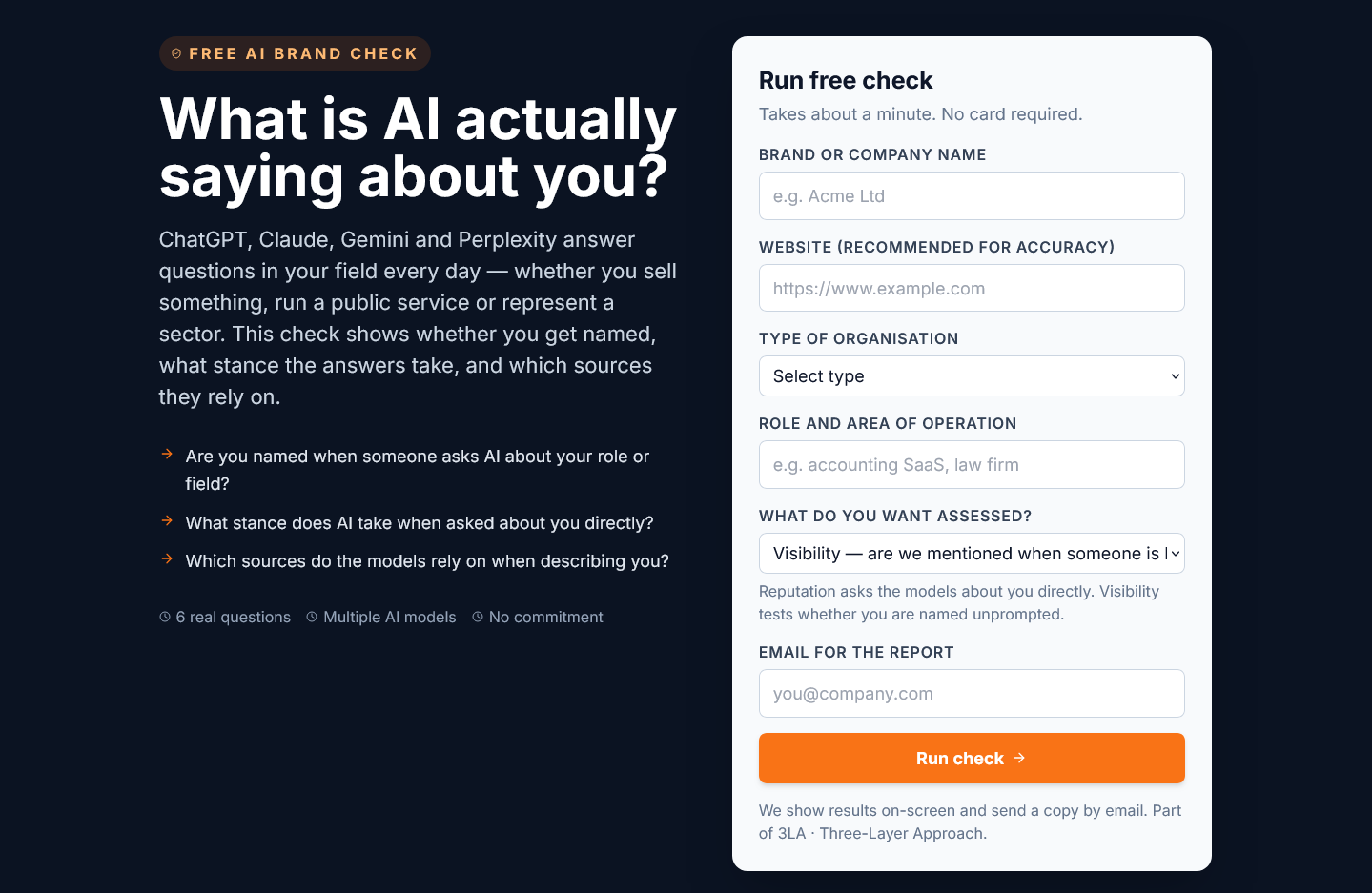
Anyone with a public brand can run a free EAE check. You give us a domain and a couple of key entities you want validated - people, products, prices, positions. Within minutes you get a report showing where the major LLMs currently disagree with your ground truth, plus a prioritised list of what to fix first.
Run a free EAE check See where GPT, Claude, Gemini and Perplexity currently contradict your own facts - no commitment required. Start your free EAE check →
Agency partner track Run these checks on behalf of your clients and share the fix roadmap under your own brand. Talk to Nettpilot about the partner track →
Nickolass Jensen is the founder and CEO of Nettpilot AS, a Norwegian digital agency specialising in technical SEO, GEO, and WooCommerce development. He is the creator of the Three-Layer Approach™ (3LA) - a structured methodology for diagnosing and improving AI citation visibility.
Related articles
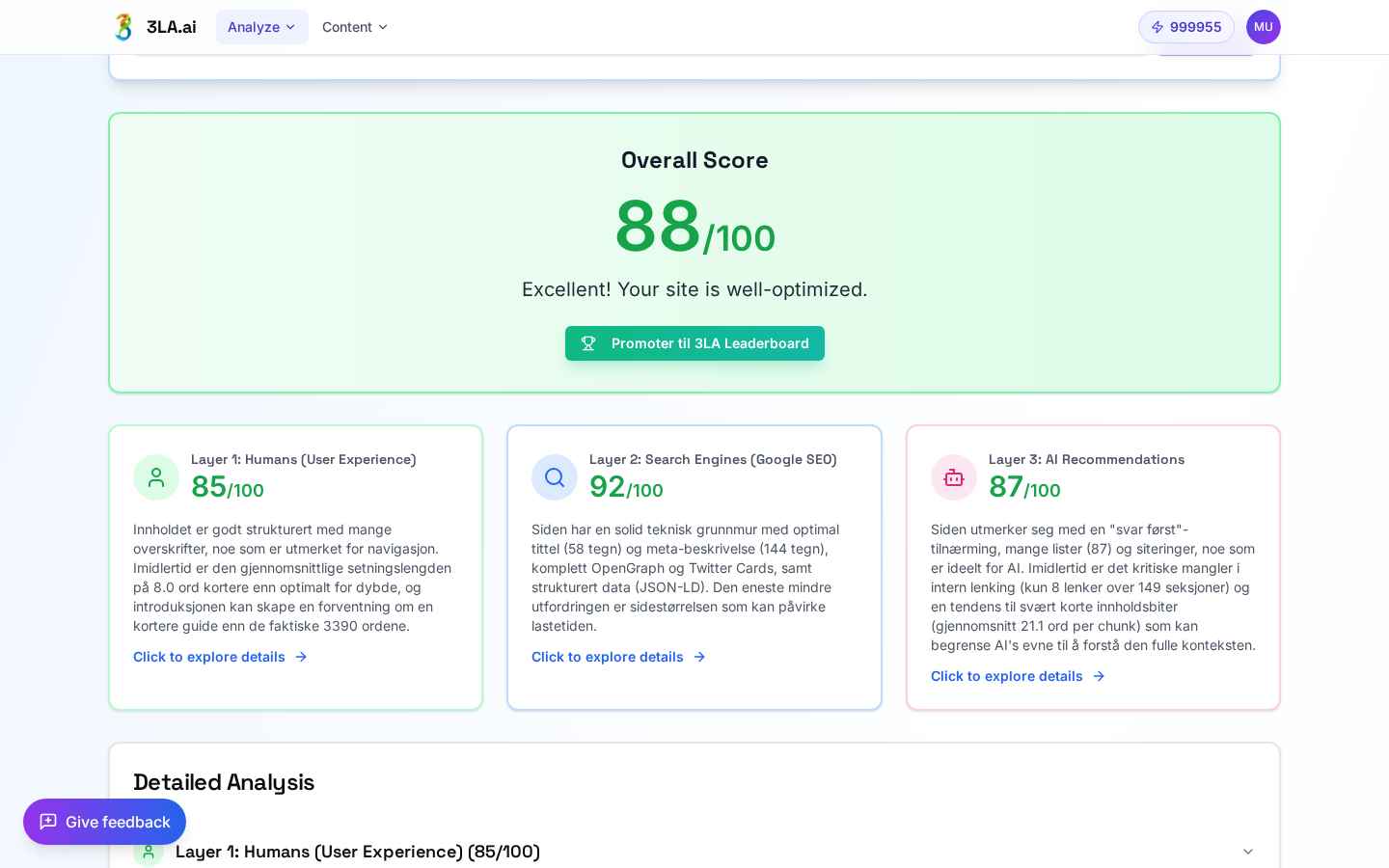
Your SEO Audit has a missing Layer
Most audits cover two layers. The one they skip is where AI visibility is decided.
7 min
AI SEO Tools Comparison in 2026: A Strategist's Honest Take
AI visibility tools answer three different questions. Is my site built so AI can read and trust it? How often does AI mention me? Is a change in those mentions real? Classic SEO suites answer the first question only partly. Daily trackers such as Peec AI and Profound answer the second, across many engines. The Three-Layer Approach (3LA) answers the first with deterministic structural scoring and the third with repeated sampling and confidence intervals. Most teams need more than one of these. The useful thing is to know which question each tool is actually answering.
8 min