What is AI actually saying about you?
ChatGPT, Claude, Gemini and Perplexity answer questions in your field every day — whether you sell something, run a public service or represent a sector. This check shows whether you get named, what stance the answers take, and which sources they rely on.
- Are you named when someone asks AI about your role or field?
- What stance does AI take when asked about you directly?
- Which sources do the models rely on when describing you?
THE PROBLEM
You have dashboards for Google. Not for what AI says.
As buying journeys shift from search results to AI conversations, insight disappears. Most companies have no idea whether they are recommended, ignored, or described from the wrong sources.
Invisible
AI does not mention you when customers ask about your category. Competitors get the recommendation instead.
Wrong sources
Models describe you from directories, old press, or third-party sites — not from your own content.
Losing the comparison
When AI ranks alternatives you land at the back. Without data it is impossible to prioritize.
WHAT YOU GET
Four concrete answers
Not a generic score. A snapshot of how the models that matter actually handle your brand.
Visibility per model
Which models mention you when asked about your category — and which leave you out entirely.
Accuracy vs. your website
We pull facts from your own domain and check whether what AI says matches, drifts, or contradicts.
Competitive landscape
Who gets pulled up ahead of you when AI compares alternatives in your category.
Prioritized next steps
Concrete signals on what to fix first — content, entity signals, or authority.
What this check does not do
The accuracy score uses your website as ground truth. For full per-prompt fact-checking — with your own curated ground truth and drift alerts over time — you need the paid Entity Accuracy Engine.
HOW IT WORKS
From form to insight in about a minute
Questions follow your organisation’s role and selected focus: visibility, reputation or factual accuracy.
You provide the brand
Name, domain, category, business type. We tailor the prompts and models to your situation.
We run the check
A handful of realistic question variants across multiple AI models. In parallel we read your own website to have something to compare against.
You read the report
Visibility, accuracy, sources, and competitors — plus clear signals on what to fix first.
See what AI says about you.
No commitment — just insight you cannot get from Analytics or Search Console.
Start free checkChoose what you want to measure
Visibility tests whether you are mentioned without being named in the question. Reputation asks directly about your organisation and examines the tone of the answer. Factual accuracy compares claims with the information available on your website. These are different tests, not three labels for the same score.
Read a check as a snapshot
Review the questions, models and cited sources alongside the result. A small set of answers is not a complete account of public opinion or a definitive fact check. If your website blocks the crawler, the report cannot use its content as a reliable comparison source. Recurring monitoring belongs in the broader 3LA workflow.
Frequently Asked Questions
What does the free AI brand check test?
It probes ChatGPT, Claude, Gemini and Perplexity with realistic questions. Choose visibility, reputation or factual accuracy as focus area.
How long does the check take?
Results in approximately 60 seconds. No login or credit card required.
What is the difference between visibility, reputation and factual accuracy?
Visibility tests organic citation. Reputation examines tone. Factual accuracy compares AI claims with your website content.
Can I see which sources the AI cited?
Yes. Every answer shows the URLs the model cited so you can verify each claim.
What should I do after the check?
Review cited sources and tone. If visibility is low, use the three-layer audit. For ongoing monitoring, upgrade to Brand Analyzer.
FROM THE BLOG
Latest field notes.

Smart credit management strategies for AI visibility
Optimize your AI visibility budget. Discover smart strategies to prevent credit waste, avoid data gaps, and maximize insights across AI visibility platforms. Learn more today.
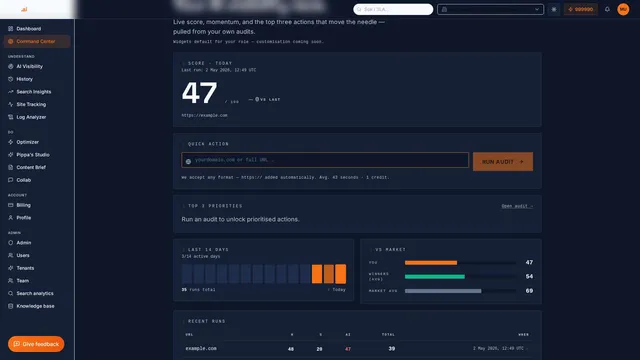
Why we rebuilt the 3LA audit: Honest numbers and page-aware scoring
A review of one audit report found four figures that did not hold up. We traced each one to the code, fixed it, and changed how the audit judges a page: by what kind of page it is. The growing amount of AI-slop is why 3LA now focus on precision even more.

AI SEO Tools Comparison in 2026: A Strategist's Honest Take
AI visibility tools answer three different questions. Is my site built so AI can read and trust it? How often does AI mention me? Is a change in those mentions real? Classic SEO suites answer the first question only partly. Daily trackers such as Peec AI and Profound answer the second, across many engines. The Three-Layer Approach (3LA) answers the first with deterministic structural scoring and the third with repeated sampling and confidence intervals. Most teams need more than one of these. The useful thing is to know which question each tool is actually answering.