Glossary — the 3LA vocabulary
Definitions of every term you need to understand AI citation readiness, Generative Engine Optimization and the three-layer method.
Explore the knowledge graph visuallyFoundations
· 21 termsStart here — the umbrella framework everything else builds on.
AI Citation Visibility
coreThe measurable state of being the cited source inside an AI-generated answer — not merely present in the results. 3LA measures citation rate and sentiment across five LLMs: ChatGPT, Claude, Gemini, Perplexity, and Mistral. Critically distinct from AI Visibility: visibility means a page ranks or appears; citation visibility means the model quotes YOU as the authority.
Nettpilot AS
coreNorwegian digital strategy and AI search optimization agency. Developer of the Three-Layer Approach (3LA) platform, Nettpilot AI Context Engine, and Nettpilot Guardian. Founded by Nickolass Jensen. Operating globally from Jevnaker, Norway.
Pippa
coreThe creative content-developer persona of the 3LA Platform, inspired by Pippi Longstocking. Turns Ulf's analysis and recommendations into publish-ready, AI-optimised text that performs across all three layers. Asks clarifying follow-up questions to lock in the right tone, intent and atomic, citable structure before content goes to Content Optimizer. Powers Pippa's Studio and Collab.
Three-Layer Approach (3LA)
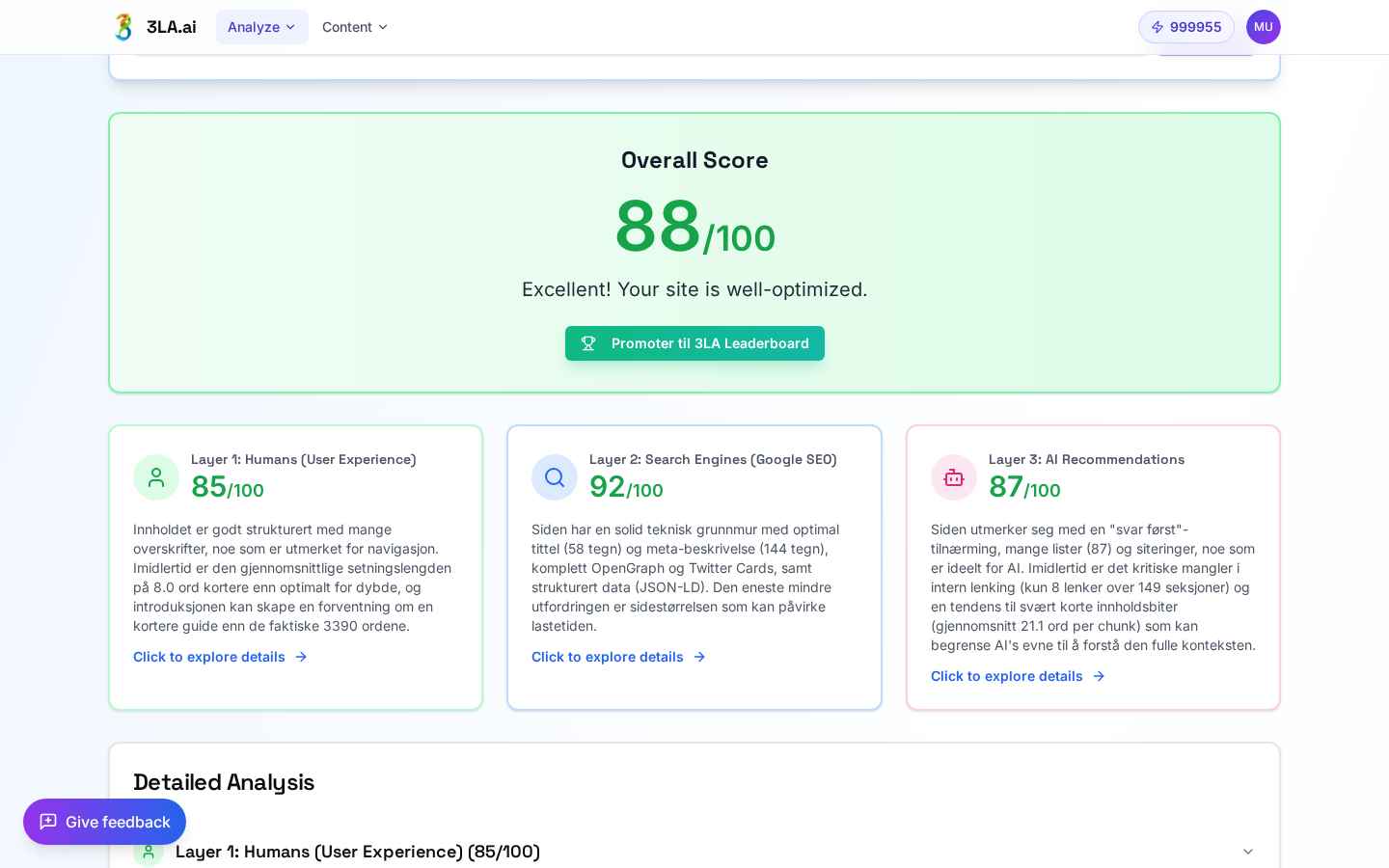
coreA content optimization framework that scores web content across three layers: human experience (L1), search engine visibility (L2), and AI citation readiness (L3).
Ulf
coreThe lead analyst persona of the 3LA Platform. An AI persona powered by large language models that runs deep three-layer audits across Human Clarity (L1), Search Visibility (L2) and AI Citation Readiness (L3). Returns brutally honest, prioritised recommendations grounded in the LayerScore. Hands findings to Pippa for content creation. Inspired by the archetype of a demanding coach.
Model Drift
coreStatistically significant changes in an AI model's citation behaviour over time following training updates – brands that were frequently cited can suddenly disappear from AI responses without warning.
Fragmentation Problem
coreThe situation where content teams optimise for one audience at a time - humans, search engines or neither - without achieving synergy across all three layers simultaneously.
L1 Human Layer
coreThe first layer in the Three-Layer Approach framework. Measures 18 metrics including readability scores, sentence length, trust signals, E-E-A-T markers, accessibility, and friction. Weight: 30% of LayerScore. Platform average L1: 73/100.
L2 Search Layer
coreThe second layer in the Three-Layer Approach framework. Measures 21 metrics including technical SEO, JSON-LD structured data, Core Web Vitals, canonical and hreflang hygiene, internal linking, heading hierarchy, and crawlability. Weight: 40% of LayerScore. Platform average L2: 72/100.
LayerScore
coreThe composite content visibility score produced by the Three-Layer Approach framework. Formula: L1 × 30% + L2 × 40% + L3 × 30%. Scale 0–100.
Bot Detection
coreServer-side detection and classification of AI crawlers visiting a website. Part of the Signals layer in 3LA. Logs which AI systems crawl which pages, at what frequency, and whether they access machine-readable files like /entitymap.json and /llms.txt. Enables measurement of actual EntityMap consumption by AI systems.
Generative Engine Optimization
coreThe practice of optimizing content to be retrieved and cited by AI-powered answer engines. 3LA's Layer 3 score measures GEO performance as citation rate and sentiment across ChatGPT, Claude, Gemini, Perplexity, and Mistral. Distinct from classical SEO which optimizes only for search engine crawlers.
L3 AI Layer
coreThe third layer in the Three-Layer Approach framework. Measures 12 metrics including Structural Proof Gap, Citation-Worthiness, Citation Readiness, Answer-First Format, LLMs.txt, and Chunk Optimization. Citation rate measured across ChatGPT (GPT-5.2), Claude Sonnet 4.6, Gemini 3.1 Pro in every audit. Weight: 30% of LayerScore. Platform average L3: 68/100. Typical lift after optimisation: +28 points.
Retrieval-Augmented Generation
coreA technique used to improve the quality, accuracy, and freshness of AI responses by grounding them in retrieved source documents. RAG systems retrieve relevant content from indexed sources before generating a response. EntityMap improves RAG output quality by providing structured, pre-verified entity relationships and evidence chunks rather than requiring the model to infer relationships from unstructured prose.
Zero-Click Economy
coreA digital environment where users receive answers directly from AI tools without visiting the source website, making AI citation the new form of visibility.
A2B Economy
coreThe emerging economy in which AI agents — not humans — conduct research, evaluate options, and make purchase decisions on behalf of users. In A2B (Agent-to-Business) interactions, the agent retrieves from structured, verifiable sources. Organisations without a clean, connected entity graph are not in the agent's consideration set. EntityMap is the infrastructure required for A2B visibility.
Chunk Optimization
coreStructuring content into self-contained units of 100–150 words where each section addresses one specific question - making it easy for AI models to extract, understand and cite the information.
Query Fan-out
coreA technique used by AI search systems to generate multiple concurrent, related sub-queries from a single user query in order to retrieve more comprehensive results. Example: 'how to fix a weedy lawn' fans out to 'best herbicides', 'remove weeds without chemicals', 'prevent weeds'. Content organised as Atomic Content Units with clear topic coverage is more likely to be retrieved across fan-out queries.
Atomic Content Unit
coreThe practice of structuring information as the smallest possible independent units of meaning, designed to be easily ingested, re-combined, and repurposed by AI agents without losing context. Atomic Content Units enable AI systems to extract single factual claims cleanly rather than inferring from unstructured paragraphs. Increases Citation Rate and reduces hallucination risk.
Content Audit
coreA systematic evaluation of a website's content quality across all three layers to identify gaps and improvement opportunities.
Brand Mention Tracking
coreMonitoring and measurement of how and where a brand is mentioned across AI-generated responses. Part of the Brand Analyzer capability in 3LA. Tracks mention frequency, sentiment, context, and competitor share-of-model across ChatGPT, Claude, Gemini, Perplexity, and Mistral.
Generative Engine Optimization
· 8 termsThe market shift that makes the three-layer approach necessary.
AI SERP
GEOThe AI-generated answer section in search results (e.g. Google AI Overviews, Bing Copilot). Appearing here is the GEO equivalent of ranking number one.
Citeability
GEOA structural property of a page that makes it easy for an AI model to quote: short factual sentences, clear headings, FAQPage schema, canonical URL, named expert author.
Dark Opportunities
GEOA page with meaningful impressions in Google Search Console and Bing Webmaster Tools that never appears in ChatGPT, Perplexity or Gemini AI Overviews - findable to humans via traditional search, but effectively invisible to AI.
AI Dark Traffic
GEOTraffic and brand exposure originating from AI models that is not traceable in standard analytics tools – users who discover you via ChatGPT or Perplexity do not appear as AI referrals in GA4 or GSC.
Sycophancy
GEOThe tendency of AI models to confirm a user's implicit preferences rather than providing neutral, fact-based answers - a form of confirmation bias that influences which brands AI recommends.
Answer Engine Optimization (AEO)
GEOA subset of GEO focused on structuring content to directly answer specific questions, making it extractable by AI answer engines.
Prompt Optimization
GEOThe practice of structuring content so that it aligns with the types of prompts users submit to AI models, increasing the likelihood of citation.
Platform-Segmented GEO
GEOA GEO strategy that differentiates optimization tactics per AI platform, recognizing that ChatGPT, Claude, Perplexity, and Gemini have different citation patterns and user bases.
Layer 1 — Human Clarity
· 6 termsHow real readers experience your content.
Readability Score
L1A measure of how easily human readers can understand content, based on sentence length, vocabulary complexity, and logical flow.
Cognitive Load
L1The mental effort required to process and understand content. Low cognitive load leads to higher engagement and trust.
Trust Signals
L1Visual and textual elements that establish credibility with human readers: testimonials, partner logos, author bios, certifications, and privacy policy.
E-E-A-T
L1Experience, Expertise, Authoritativeness, Trustworthiness. Google's quality framework for content credibility, also used by AI models to assess citation worthiness.
UX Clarity
L1The degree to which a page's layout, navigation, and visual hierarchy guides users intuitively toward their goal.
Above the Fold
L1The portion of a webpage visible without scrolling. Critical real estate for first impressions and conversion.
Layer 2 — Search Visibility
· 7 termsHow search engines parse and rank your pages.
Technical SEO
L2The practice of optimizing website infrastructure – crawlability, indexability, site speed, and mobile-friendliness – to improve search engine rankings.
Schema Markup
L2Machine-readable code (JSON-LD using Schema.org vocabulary) added to web pages to help search engines and AI models understand content meaning and context.
Internal Linking
L2Hyperlinks connecting pages within the same domain. Strong internal linking improves crawlability, distributes page authority, and increases semantic depth.
Crawlability
L2The ability of search engine and AI crawlers to access and index a website's content. JavaScript-heavy pages often have poor crawlability.
Semantic HTML
L2HTML that uses meaningful tags (e.g. article, section, h1) to convey the structure and meaning of content to both browsers and crawlers.
Core Web Vitals
L2Google's set of metrics measuring real-world user experience: Largest Contentful Paint (LCP), Interaction to Next Paint (INP), and Cumulative Layout Shift (CLS).
Canonical Tag
L2An HTML element that tells search engines which version of a page is the master copy, preventing duplicate content issues.
Layer 3 — AI Citation Readiness
· 10 termsHow AI engines decide whether to quote you.
AI Visibility
L3A measure of how frequently and accurately AI models reference, cite, or recommend a brand or piece of content in their generated responses.
Hidden Citation Paths
L3Situations where AI models cite a secondary source or aggregator instead of the original creator – you produce the content, but credit and authority go elsewhere.
First-View Content
L3Content visible within the first 2,000 characters of extracted text without JavaScript rendering – AI crawlers do not run JS, and content requiring rendering is invisible to them regardless of quality.
Hidden Content Paradox
L3The situation where modern UX practices such as accordions, tabs and lazy loading improve human experience - but make content invisible to AI crawlers that only read the initial HTML response.
Citation Gap
L3The absence of clear attribution markers, fact anchors and authoritative signals in content - the elements AI models require to cite a source, and which are frequently missing from marketing-focused content.
Answer-First Design
L3A content structure where each paragraph or section opens with the direct answer to the question posed by the heading - optimised for AI models that extract answers from the first sentences of a text block.
Citation Readiness
L3The degree to which content is structured, authoritative, and clear enough to be cited by an AI model as a source in a generated answer.
llms.txt
L3A proposed standard file (similar to robots.txt) that communicates to AI crawlers which content should or should not be indexed by large language models.
AI Crawlability
L3The ability of LLM agents and AI crawlers to access, parse, and understand a website's content for use in training or real-time retrieval.
Entity Recognition
L3The process by which AI systems identify and categorize specific people, places, organizations, products, or concepts within content.
Measurement
· 11 termsHow we quantify Layer 3 progress over time.
Structural Proof Gap
metricA 3LA metric measuring how many of a page's intent-critical claims — price, service, FAQ, rating, organization, location — are proven with Schema.org markup rather than merely asserted in prose. Platform data: 76.2% low gap, 23.8% medium gap across 909 claims tracked. An LLM cites what it can verify.
Citation Rate
metricThe percentage of AI-generated responses that include a given brand or URL as a cited source. Measured across up to five LLMs by the 3LA platform. Primary KPI for AI visibility and GEO strategy. Platform data: 16% of audited pages have zero citation rate despite ranking in classical search.
Prompt Sampling
metric3LA's method of feeding 10-20 brand-scoped prompts to multiple AI models in parallel, then aggregating mention rate, citation rank and sentiment into a reproducible L3 score.
GEO Gap
metricThe difference between a site's L2 Search score and L3 AI score in 3LA - a high GEO Gap indicates strong SEO visibility but poor AI citability. Formula: L2 Score − L3 Score.
L1 Score
metricThe human experience layer score (0–100). Measures readability, trust signals, UX clarity, and cognitive flow.
Share of AI Voice (SOAV)
metricThe share of AI-generated answers within a category where your brand is mentioned – the primary KPI for GEO strategy, analogous to Share of Voice in traditional marketing.
Citation Decay
metricThe gradual decline in AI citation rate for content over time – the AI equivalent of ranking decay, traceable as falling mention rate in Brand Analyzer trends.
L2 Score
metricThe search visibility layer score (0–100). Measures technical SEO, structured data, crawlability, and internal linking.
L3 Score
metricThe AI citation readiness score (0–100). Measures how likely AI models are to cite your content in generated answers.
Consistency and Redundancy Gap
metricA 3LA metric measuring whether the same fact is grounded in two or more independent structures — body text, table, and JSON-LD. For an inference engine, data redundancy equals trust. CRG quantifies how single-sourced, and therefore fragile, a site's information architecture is.
Citation Worthiness
metricA sub-score within L3 measuring whether content contains verifiable, well-sourced claims that AI models will trust and cite.
Tools
· 22 termsThe 3LA studio — twelve stations wired as one workflow.
3LA Audit
toolA full three-layer analysis of a URL, returning L1, L2, and L3 scores with prioritized recommendations. Completes in approximately 45 seconds.
3LA Leaderboard
toolPublic world rankings of individual pages scored by the Three-Layer Approach framework. Pages are evaluated independently across L1 Human, L2 Search, and L3 AI layers. Minimum score for inclusion: 55/100. Engine: Gemini 3.1. Reference Lab entry: nettpilot.com at LayerScore 88 (L1:95, L2:92, L3:84). Current #1: posten.no (84). Demonstrates deterministic scoring — same URL produces same ranking on every run.
3LA Platform
toolAI visibility audit platform that scores any URL across three layers simultaneously: L1 Human experience, L2 Search engine signals, and L3 AI citation rate. Produces a deterministic LayerScore in approximately 45 seconds. Measures citation rate across ChatGPT (GPT-5.2), Claude Sonnet 4.6, Gemini 3.1 Pro, Perplexity (Sonar), and Mistral Large. 303 domains audited, 1,385 total audits, 59 active users.
3LA Probe
toolA server-side probe used by the Log Analyzer to detect and classify AI-crawler and bot activity in server logs — the base unit for measuring how AI agents actually access a site.
Citation Tracker
toolA 3LA platform product that tracks when and how a brand is cited across AI-generated responses over time. Enables longitudinal measurement of GEO strategy effectiveness. Full five-model coverage: ChatGPT, Claude, Gemini, Perplexity (Sonar), and Mistral Large.
Classification Accuracy
toolSelf-learning classification system in the 3LA platform. Automatically classifies business type and page type for each audited URL. Logs user corrections and aggregates error patterns to tune classification heuristics over time. Current accuracy: 85.7% across 21 classified URLs, 3 corrected. Most common misclassifications: product → content (2x), faq → product_page (3x). Accessible via admin Auto-tuning report.
LLM Probe
toolA single parallel execution of a standardised prompt against multiple LLMs (Claude, GPT, Gemini) to measure whether a brand appears in AI-generated answers — the base unit of Brand Analyzer.
Metrics Library
toolComplete reference of 51 deterministic metrics used in 3LA LayerScore audits. L1 Content Quality (18 metrics): Readability, Heading Structure, Image Accessibility, Navigation Clarity, Visual Hierarchy, Call-to-Action Clarity, Mobile Responsiveness, Content Scannability, Internal Link Structure, and others. L2 Technical/Structure (21 metrics): Structured Data, Schema Types, Entity Recognition, Canonical Tags, Robots.txt, Sitemap.xml, HTTPS Security, Semantic HTML, and others.
Signals
toolCentral tracking hub in the 3LA platform. Aggregates three data sources per connected domain: Site Tracking (JavaScript analytics), Bot Tracker (server-side AI bot detection and log analysis), and Search Data (GSC/Bing integration). Displays connection status per source. Supports WordPress sites via dedicated connector. 8 sites connectable, 2 fully connected required for complete visibility.
State of GEO
toolLive, public research report aggregating anonymised audit data from every 3LA audit ever run. Reports score distribution, monthly L1/L2/L3 trend lines, failure rates per layer, most commonly missing structural elements, and market presence by TLD. Data computed on demand. No URLs, no user data, no PII. Aggregated in 15-minute caches.
Brand Analyzer
toolA 3LA platform product that tracks brand mentions and citation rate across five AI models: ChatGPT (GPT-5.2), Claude Sonnet 4.6, Gemini 3.1 Pro, Perplexity (Sonar), and Mistral Large. Provides Share-of-Model data and competitive AI visibility benchmarking. Driven by Capability Profile data.
Capability Profile
toolThe central brand truth source in the 3LA platform. Defines brand name, product name, tagline, description, services, products, value propositions, key features, ICP (industries, roles, company size, pains), competitors, target regions, tone of voice, must-include terms, avoid terms, and methodology across L1/L2/L3. Auto-fills from domain crawl using Gemini. All Brand Analyzer probes, Content Optimizer outputs, and Pippa's Studio sessions are derived from this profile.
Command Center
toolThe primary dashboard in the 3LA platform. Surfaces live LayerScore with L1/L2/L3 breakdown, top 3 prioritised audit actions, search momentum (GSC/Bing), site tracking connections, VS Market benchmark, recent audit runs, public leaderboard status, and Pippa calibration. Entry point for AI visibility management.
3LA Content Optimizer
toolA 3LA platform product that rewrites and optimizes content for all three layers simultaneously using deterministic SPG/CRG scoring. Identifies which structural fixes produce the highest LayerScore lift. Powered by Pippa persona.
Log Analyzer
toolA 3LA tool that parses server logs to identify which AI agents and search bots visit your site – and what they are looking for but not finding.
Site Tracking
toolJavaScript-based analytics tracking component within the 3LA Signals layer. Monitors visitor behaviour, page performance, and engagement signals across connected domains. One of three required data sources for full Signals connectivity.
Master Analytics
toolAggregated analytics dashboard across all 3LA audits. Tracks GEO adoption rates, technical readiness, Structured Data, AI content readiness, Citation-Worthiness , Answer-First Format, Citation Readiness, SPG distribution, monthly trends, industry benchmarks, and Pippa calibration across all domains audited.
Pippa's Studio
toolDomain-aware content production environment in the 3LA platform. Powered by Pippa persona. Offers content templates (FAQ Section 30s, About Us Page 45s, Blog Post 60s, Product Description 30s, Social Media) with estimated production times. Supports AI model selection (default: Gemini 2.5 Flash). Sessions saved as Chat History. Reads domain context from Capability Profile.
Content Brief
toolA structured document defining content goals, target audience, key questions, and optimization requirements for a new piece of content.
Hero A/B/C Editor
toolA 3LA tool for testing multiple headline and CTA variants on landing pages, with real-time impression and conversion tracking.
Quick Audit Widget
toolAn embeddable widget allowing visitors to run a 3LA audit directly on a landing page without logging in.
Collab
toolMulti-agent content optimization interface in the 3LA platform. Ulf (the Auditor) diagnoses issues and creates recommendations. Pippa (the Optimizer) creates content based on those findings. Users can address either agent individually or both for collaborative problem-solving. Flow: Ulf diagnoses → Pippa creates → Optimize & Publish.
A shared vocabulary for AI visibility
Use this glossary to distinguish page readiness from observed performance. GEO describes work to make content discoverable and citeable by generative systems. Structured data describes entities and relationships in a machine-readable format. Neither is a guarantee of an AI recommendation.
Read the denominator before comparing rates
Mention rate, citation rate and search click-through rate count different events. A prompt-based mention rate cannot be compared directly with citations per search impression. Check the population, reporting period and minimum sample whenever a percentage is used to justify an editorial decision.
How the terms are organized
Terms are grouped into seven categories that follow the 3LA mental model: Foundations (the umbrella framework), GEO (the market shift), Layers 1–3 (human clarity, search visibility, AI citation readiness), Measurement (how we quantify progress) and Tools (the 3LA studio). Reading top to bottom builds a complete picture of AI-readiness methodology.
- Foundations: the Three-Layer Approach framework, Layerscore, the audit concept.
- GEO (Generative Engine Optimization): the emerging discipline of making content citable by AI engines.
- Layer 1 — Human Clarity: readability, heading structure, scannability, BLUF format.
- Layer 2 — Search Visibility: structured data, meta tags, canonical setup, JSON-LD.
- Layer 3 — AI Citation Readiness: chunk optimisation, answer-first format, citation readiness, grounding signals.
- Measurement: citation rate, mention rate, Share-of-AI-Voice, confidence bands.
- Tools: the 20 connected modules in the 3LA platform — from audit to Command Center.
Frequently Asked Questions
What is Generative Engine Optimization (GEO)?
GEO is the practice of structuring content so that AI-powered search engines and language models can discover, understand and cite it. Unlike traditional SEO which focuses on ranking in search results, GEO focuses on being quoted or referenced in AI-generated answers.
What does the Layerscore measure?
Layerscore is the combined three-layer score that rates any URL across Layer 1 (human readability), Layer 2 (search-engine access) and Layer 3 (AI-citability). It tells you how ready a page is to be found, understood and cited across all three audiences.
What is the difference between citation rate and mention rate?
Citation rate measures how often AI models reference your content with an attributed source link. Mention rate measures how often your brand or domain is named in AI-generated responses, regardless of whether a source link is provided. They count different events and should not be compared directly.
What is Share-of-AI-Voice?
Share-of-AI-Voice measures how often a brand is cited in AI-generated responses relative to competitors for the same set of prompts. It is the AI equivalent of Share-of-Voice in traditional media monitoring — the proportion of the conversation that belongs to you.
What is structured data and why does it matter for AI?
Structured data (typically JSON-LD using the Schema.org vocabulary) is machine-readable markup that describes entities, relationships and facts on a page. AI crawlers and language models use structured data to verify claims, extract entities and determine whether content is authoritative enough to cite.
FROM THE BLOG
Latest field notes.

AI SEO Tools Comparison in 2026: A Strategist's Honest Take
AI visibility tools answer three different questions. Is my site built so AI can read and trust it? How often does AI mention me? Is a change in those mentions real? Classic SEO suites answer the first question only partly. Daily trackers such as Peec AI and Profound answer the second, across many engines. The Three-Layer Approach (3LA) answers the first with deterministic structural scoring and the third with repeated sampling and confidence intervals. Most teams need more than one of these. The useful thing is to know which question each tool is actually answering.
A Practical Setup Guide for 3la.ai
Want your brand to be preferred and cited by ChatGPT, Perplexity and Google AI Overviews? This guide walks you through setting up 3la.ai in under an hour, so you can close visibility gaps, optimise your content and compete in AI search (GEO).

BrightonSEO 2026 Just Validated the Three-Layer Approach
BrightonSEO's 10th anniversary edition, held October 8–9, 2026 and drawing roughly 4,500 attendees, was dominated by one theme: GEO (Generative Engine Optimization), AI citations, and agentic recommendations. For anyone building on the Three-Layer Approach, this wasn't new information - it was confirmation.