The Manifesto
Data-Driven Framework for Digital Visibility in the AI Era
AI has changed the rules overnight.
Traditional SEO metrics no longer capture the full picture of visibility.
The digital space has blind spots.
Humans overlook them.
Machines can't read them.
The gap is widening.
Fast.
Those who learn to navigate these new frontiers will own the next decade of digital visibility.
The rest?
They'll wonder where their traffic went.
Layer 1: Humans (User Experience)
- Readability, engagement, and conversion
- Visual hierarchy and content structure
- The foundation - if humans don't engage, nothing else matters
Layer 2: Search Engines (Google & Bing)
- Rankings, CTR, impressions, and technical SEO
- Semantic HTML and structured data (Schema)
- Still drives the majority of organic traffic
Layer 3: AI Recommendations
- 40%+ of searches now via AI assistants
- Citation frequency and first-view accessibility
- The fastest-growing channel - often overlooked
- •Deadly assumptions about SEO and AI
- •Brands winning in Google but invisible in AI
- •The cost of ignoring AI visibility (backed by data)
Methodology:
Where:
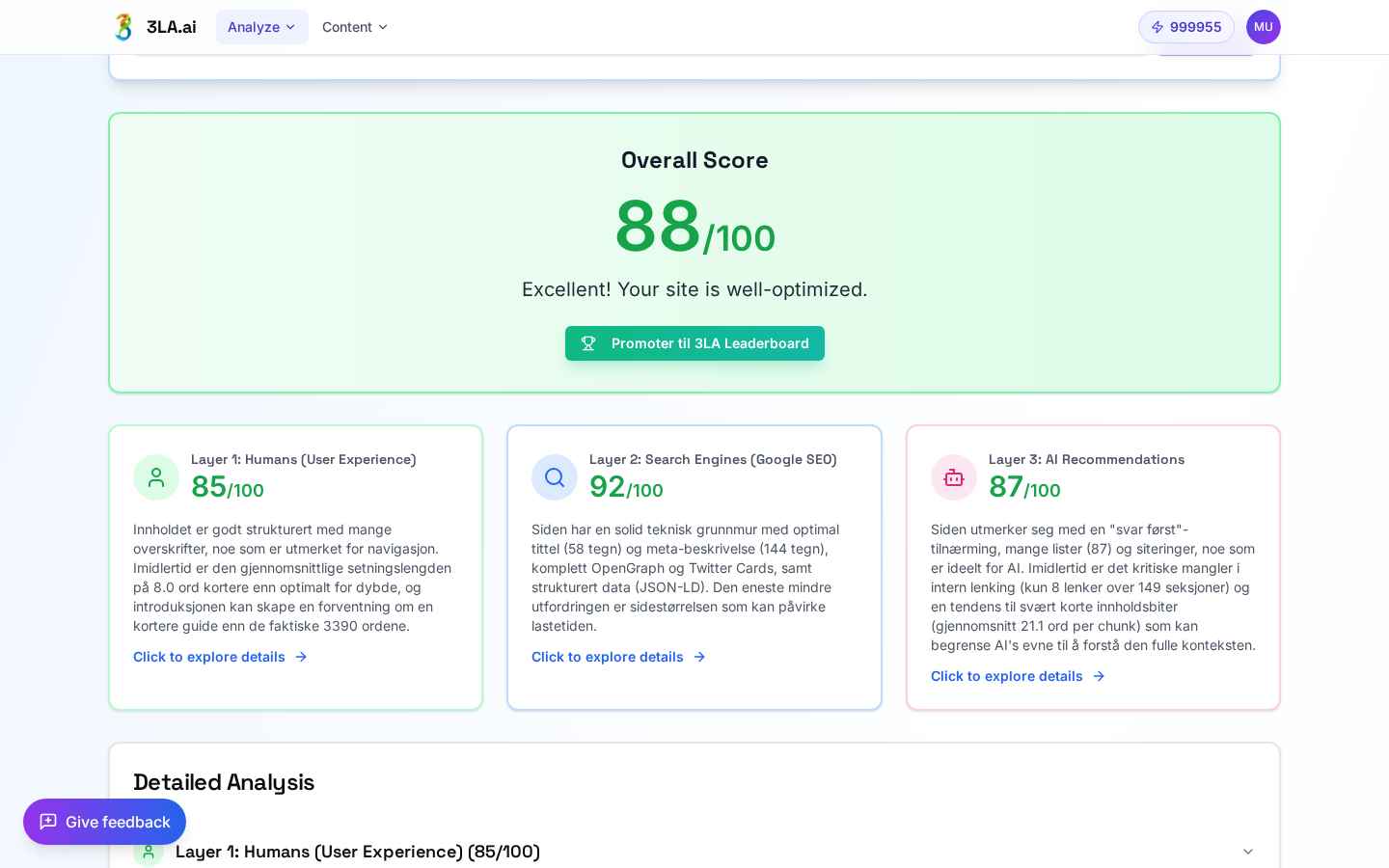
- L1 (Human) = Readability & user experience score (0-100)
- L2 (Search) = Technical SEO & structured data score (0-100)
- L3 (AI) = AI citation readiness & LLM accessibility (0-100)
The 10-Second Prompt
"Hyper-efficient, high-leverage input that maximizes performance with ZERO WASTE."
We reject "pleasability AI" - tools that make you feel good about mediocre results. Our philosophy, inspired by Olympic sprint coaching, focuses on precision over volume,honesty over comfort, and mastery over measurements.
What This Means For You:
We DON'T say:
"Your 65/100 is a good start!"
We DO say:
"65/100 means you're losing 35% of potential traffic to competitors. Here's how to fix it."
❌ Other Tools:
- • Generic, pleasant feedback
- • Long lists of equal priority
- • "Consider improving..."
- • Celebrate mediocrity
✅ The 3LA.ai Way:
- • Brutally honest diagnosis
- • ONE high-leverage fix first
- • Exact templates to execute
- • Focus on mastery
The 7 Principles:
- 1. External Focus: We tell you the outcome to achieve, not the mechanics
- 2. Rule of One: Fix THE ONE thing that matters most, then move to the next
- 3. High/Low Separation: High-impact vs low-priority. No "junk miles" advice
- 4. Individualization: Your specific deficit, not generic problems
- 5. Structured Scaffolding: Step 1, Step 2, Step 3 - crystal clear sequence
- 6. Error-Proof Execution: Exact templates you can copy-paste
- 7. Reflection & Iteration: Continuous improvement, not one-off scores
Learn More:
Read the full article that inspired our philosophy:
"We don't help you feel good about mediocre results."
We help you master content optimization through precise, high-leverage guidance.
For CMOs:
- Budget allocation across layers
- New KPIs to track
For SEO Professionals:
- Skill evolution required
- New tools and processes
For Founders:
- Competitive advantage
- Market positioning
Immediate Actions:
- Audit current visibility
- Identify gaps
Short-term:
- Optimize for AI citations
- Restructure content
Long-term:
- Become AI-native
- Own the narrative
Join the movement. Share your results. Help refine the framework.
This manifesto is based on thousands of hours analyzing real search data, hands-on SEO work, and extensive AI model testing. It reflects patterns seen in data, not theory.
Developed by Nickolass Jensen / Nettpilot.
Tested in practice. Shared openly.
Contact: hello@threelayerapproach.com | nettpilot.no | nettpilot.com
Clarity before optimisation
A page should help a person understand the answer before it asks an algorithm to rank it. Put the main point first, name the responsible organisation and support claims with sources. Structured data should clarify the visible content, not smuggle in claims that a reader cannot verify.
Make uncertainty visible
Report what was measured, over which period and with what sample. Do not turn crawler visits into implied citations, generated prompts into observed demand or a readiness score into a ranking guarantee. Better decisions begin with knowing what the evidence does not yet establish.
Separate observation from readiness
A high Layerscore means a page is well-structured for humans, search engines and AI. It does not guarantee that a language model will cite it. Citations depend on the model, the prompt and the retrieval context. Conflating a readiness score with an observed citation leads to misleading claims and poor editorial decisions.
Why these principles matter for AI visibility
As AI engines become primary discovery channels, the temptation to game citation signals grows. The manifesto exists to hold the platform accountable: every number must be verifiable, every claim must be sourced, and every distinction between diagnostic assessment and real-world observation must be explicit.
- Metric honesty protects editorial teams from acting on fabricated signals.
- Transparent methodology invites scrutiny, which builds trust with both humans and AI crawlers.
- Named authorship (Nickolass Jensen / Nettpilot AS) gives AI systems a verifiable entity to attribute.
- Open documentation (framework, GEO guide, glossary) makes the methodology citation-ready.
Frequently Asked Questions
What is the 3LA manifesto?
Six principles guiding how the platform measures and reports AI visibility: clarity before optimisation, metric honesty, separating observation from readiness, transparent uncertainty, sourced claims and named authorship.
What does metric honesty mean?
Every aggregate ships with sample size and confidence band. A placeholder is never presented as fact. Audit scores are diagnostic, not observed citations.
Why separate readiness from observation?
A high score means good structure; it does not guarantee AI citation. Conflating the two leads to misleading claims.
Who publishes the manifesto?
Nettpilot AS, the Norwegian company behind 3LA. Nickolass Jensen is the primary author.
How does it relate to the framework?
The manifesto defines the principles. The framework defines the methodology. Read the framework for operational detail.
FROM THE BLOG
Latest field notes.

AI SEO Tools Comparison in 2026: A Strategist's Honest Take
AI visibility tools answer three different questions. Is my site built so AI can read and trust it? How often does AI mention me? Is a change in those mentions real? Classic SEO suites answer the first question only partly. Daily trackers such as Peec AI and Profound answer the second, across many engines. The Three-Layer Approach (3LA) answers the first with deterministic structural scoring and the third with repeated sampling and confidence intervals. Most teams need more than one of these. The useful thing is to know which question each tool is actually answering.
A Practical Setup Guide for 3la.ai
Want your brand to be preferred and cited by ChatGPT, Perplexity and Google AI Overviews? This guide walks you through setting up 3la.ai in under an hour, so you can close visibility gaps, optimise your content and compete in AI search (GEO).

BrightonSEO 2026 Just Validated the Three-Layer Approach
BrightonSEO's 10th anniversary edition, held October 8–9, 2026 and drawing roughly 4,500 attendees, was dominated by one theme: GEO (Generative Engine Optimization), AI citations, and agentic recommendations. For anyone building on the Three-Layer Approach, this wasn't new information - it was confirmation.