One connected AI-readiness platform — 20 tools that diagnose, act and prove
3LA is not a single tool. It is a connected suite of 20 modules where every module feeds the next: the audit finds the gap, Optimizer and Pippa close it, Log Analyzer and Search Insights prove it moved, and Command Center keeps you on track. Each URL is measured against Layer 1 (humans), Layer 2 (search engines) and Layer 3 (AI systems).
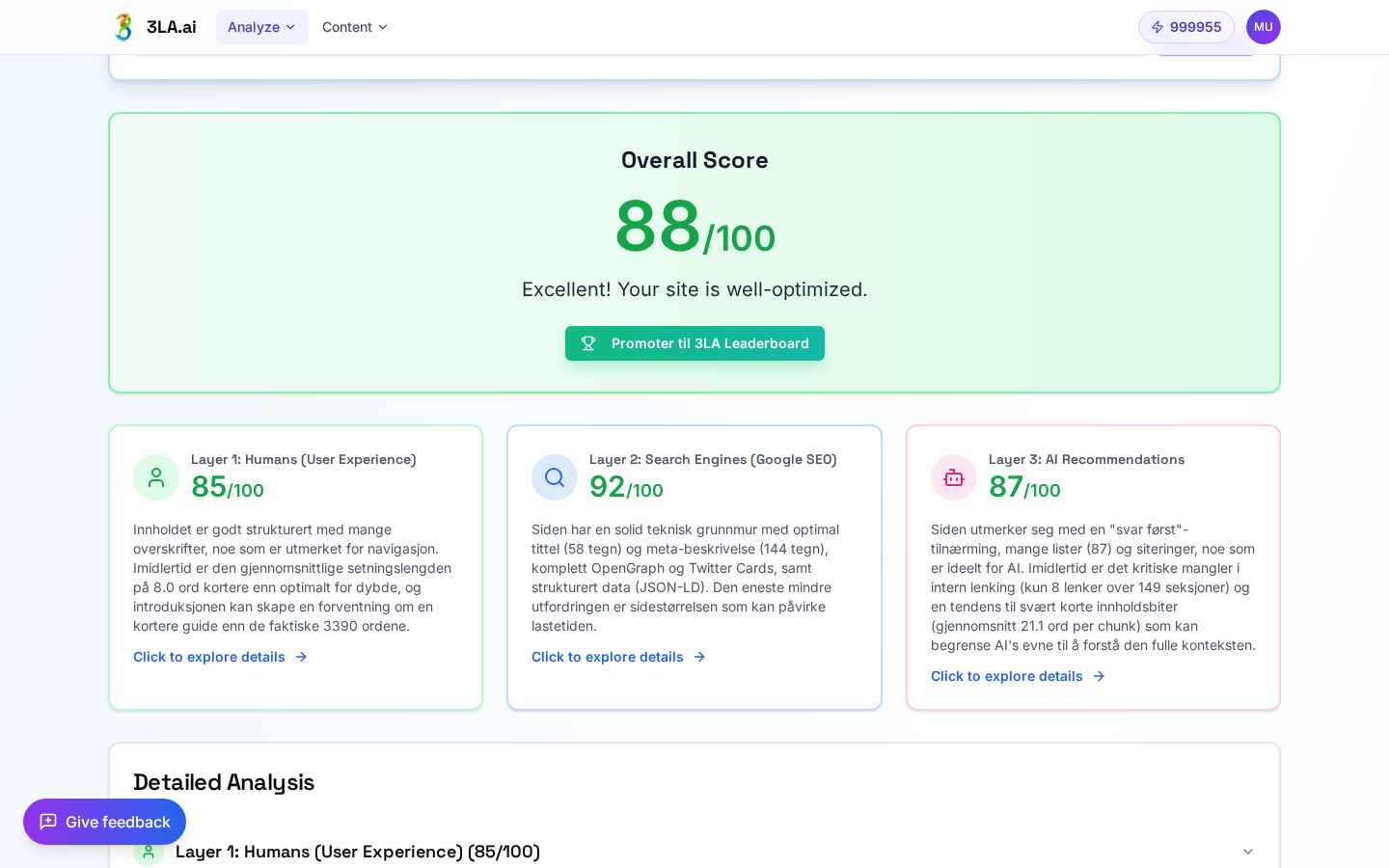
Three-layer audit: scores every URL across readability, technical SEO and AI-citability in approximately 45 seconds.
Brand Analyzer: probes GPT, Claude, Gemini, Perplexity and Mistral in parallel for citation share and sentiment.
Content Optimizer: rewrites content for all three audiences in one pass — with every recommendation attached.
Log Analyzer: isolates ChatGPT-User, PerplexityBot, ClaudeBot and Googlebot from raw server logs.
AI Insights: reads AI search data and surfaces topics where competitors are cited but you are absent.
Command Center: one cockpit that fuses every module and answers "what should I do next?".
The three-layer audit scores every URL across human readability, search-engine access and AI-citability.
Base 1: Diagnose — understand how humans, search and AI read you
The diagnostic base includes ten modules that work together. The three-layer audit measures every URL against Layer 1 (human readability), Layer 2 (technical SEO and structured data) and Layer 3 (AI-citability and grounding). Results feed directly into the Command Center as prioritised actions.
Three-layer audit: scores any URL in approximately 45 seconds across all three layers.
Brand Analyzer: probes GPT, Claude, Gemini, Perplexity and Mistral in parallel for citation share.
AI Insights: reads Bing AI search data and surfaces Dark Topics — themes your audience asks about but where you are absent.
Log Analyzer: parses raw server access logs to isolate visits by ChatGPT-User, PerplexityBot, ClaudeBot and Googlebot.
Search Insights: imports Google Search Console and joins impressions, clicks and positions directly to the audit score.
Digital Footprint: maps presence, consistency and authority of your brand signals across the open web.
Analytics: joins GA4 engagement, search visibility and AI citations per URL into one report.
Base 2: Act — close the gap the audit found
Once the diagnosis is complete, five modules help you close the gap. Content Optimizer restructures text for readability (L1), search access (L2) and AI-citability (L3) in a single pass. Pippa turns a short brief into a citation-ready draft with atomic content units and FAQ markup. The WordPress Connector publishes the improved page directly.
Content Optimizer: rewrites content for all three audiences with every recommendation visible.
Pippa Content Studio: generates structured drafts with claim-level references and semantic HTML.
Collab (Ulf × Pippa): shared thread where analyst and writer hand off with visible status badges.
Ads Playbook: builds Google Ads campaign structures from GA4 conversions and Ahrefs CPC data.
Reclaim Dark Opportunities: cross-references GSC impressions with AI citations to find pages humans find but AI does not.
Base 3: Scale — for agencies and in-house teams
Command Center is the cockpit that fuses every module: race-day status, streak, momentum, top-three priorities and a peer leaderboard. Built to answer the only question that matters — what should I do next? The WordPress Connector closes the loop by publishing directly from the platform.
Command Center: one dashboard that prioritises actions across all modules.
WordPress Connector: one-click publish from Optimizer or Pippa to your live WordPress site.
Base 4: Prove — the public layer, citable by design
Three modules that make your progress visible and verifiable. The Leaderboard ranks verified pages by layer score. State of GEO publishes aggregate trends from every page audited in the platform — monthly L1/L2/L3 averages, TLD distribution and the structural elements most often missing. Open for reference and citation.
Leaderboard: verified 3LA-optimised pages ranked by layer score — a working reference for your vertical.
Winning Templates: URLs where the full chain closed — bot read it, LLM cited it, humans clicked through.
State of GEO: the entire open GEO dataset — aggregate audit trends available for citation and analysis.
Frequently Asked Questions
What does the three-layer audit measure?
Every URL is scored across three layers: Layer 1 measures human readability (sentence length, heading structure, scannability). Layer 2 measures search-engine access (meta tags, structured data, canonical setup). Layer 3 measures AI-citability (chunk optimisation, answer-first format, citation readiness and GEO grounding signals).
How does Brand Analyzer track AI visibility?
Brand Analyzer probes five major language models (GPT, Claude, Gemini, Perplexity and Mistral) in parallel with realistic buying questions. It returns citation share per model, sentiment analysis and drift detection.
What is the Digital Footprint score?
Digital Footprint maps the signals that exist about your brand across the open web — presence on directories, consistency of NAP data and authority signals. It forms the foundation of the 3LA Overview score.
Can I publish optimised content directly to WordPress?
Yes. The WordPress Connector is a one-click bridge from Pippa or Content Optimizer to your WordPress site. Publish the rewritten page without leaving 3LA.
How does 3LA detect AI crawler activity on my site?
Log Analyzer parses raw server access logs and isolates requests from AI crawlers including ChatGPT-User, PerplexityBot, ClaudeBot and Googlebot. You see which pages they visit and how frequently they return.
What is the difference between a free audit and the paid platform?
The free audit gives a one-time three-layer score for any URL — no login or credit card required. Paid tiers unlock continuous monitoring (Brand Analyzer, AIR), server log analysis, Content Optimizer, multi-workspace support and agency features.