The State of GEO
A live, aggregate view of where websites stand on Human, Search, and AI citation readiness - drawn from every 3LA audit ever run.
At a glance
The four numbers that summarize the dataset.
Overall score distribution
How many audits land in each score band.
The L3 gap over time
Monthly average score for Human, Search, and AI citation readiness across all audits.
- AI (L3)
- Human (L1)
- Search (L2)
Where sites fail - month by month
Share of audits scoring below 50 on each layer.
- L1 fail %
- L2 fail %
- L3 fail %
Structural elements most often missing
Top issues surfaced across recent L2/L3 recommendations.
Market presence by TLD
Geographic signal from audited domains.
Methodology
All numbers are computed on demand from anonymized 3LA audit metadata (no URLs, no user data, no PII). Data is aggregated in 15-minute caches.
What the State of GEO measures
This report aggregates pages assessed with the Three-Layer Approach. It separates human clarity, search readiness and AI-readiness signals so teams can see where weaknesses cluster. The audited sample describes the pages included in the platform, not every website on the internet.
Use a benchmark to ask better questions
Compare similar pages and inspect the period and sample behind each result. A readiness score describes detectable page characteristics; it does not prove that an AI assistant has cited that page. Use repeated brand checks and source-level evidence to test whether improvements lead to more visibility.
Frequently Asked Questions
What is the State of GEO?
Monthly open dataset: aggregate L1/L2/L3 scores, TLD distribution and the most commonly missing structural elements.
How often is it updated?
Monthly, from the full audit corpus. Sample size shown alongside every number.
Can I cite the data?
Yes. Published openly for reference, research and benchmarking.
What does AI citation readiness mean?
Layer 3 measures whether a page is structured so AI engines can discover, parse and cite it.
FROM THE BLOG
Latest field notes.
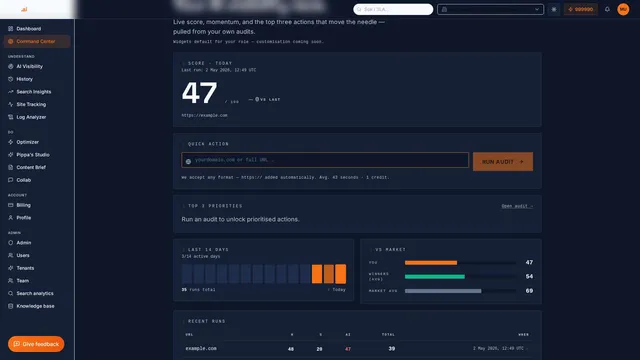
Why we rebuilt the 3LA audit: Honest numbers and page-aware scoring
A review of one audit report found four figures that did not hold up. We traced each one to the code, fixed it, and changed how the audit judges a page: by what kind of page it is. The growing amount of AI-slop is why 3LA now focus on precision even more.

AI SEO Tools Comparison in 2026: A Strategist's Honest Take
AI visibility tools answer three different questions. Is my site built so AI can read and trust it? How often does AI mention me? Is a change in those mentions real? Classic SEO suites answer the first question only partly. Daily trackers such as Peec AI and Profound answer the second, across many engines. The Three-Layer Approach (3LA) answers the first with deterministic structural scoring and the third with repeated sampling and confidence intervals. Most teams need more than one of these. The useful thing is to know which question each tool is actually answering.
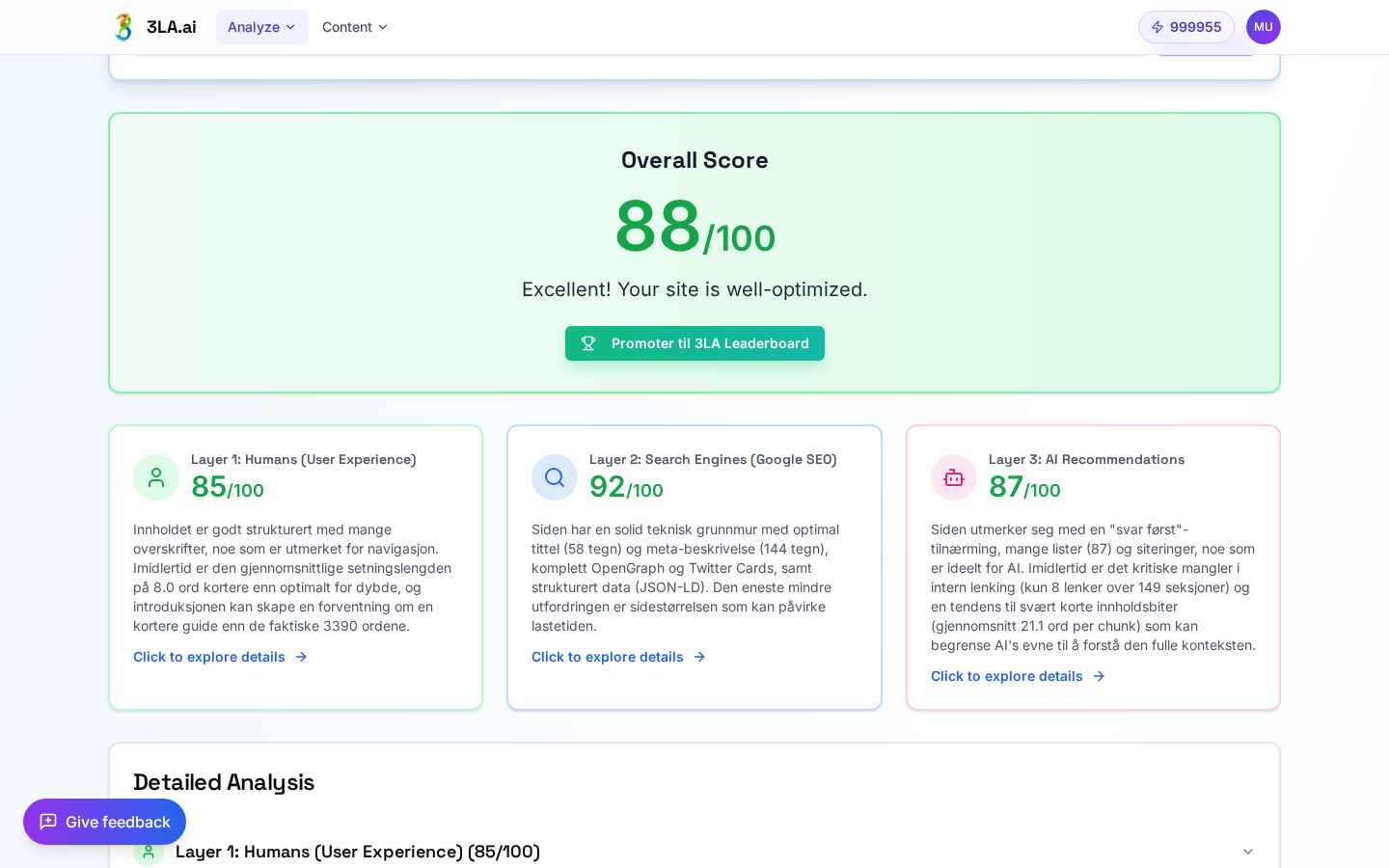
A Practical Setup Guide for 3la.ai
Want your brand to be preferred and cited by ChatGPT, Perplexity and Google AI Overviews? This guide walks you through setting up 3la.ai in under an hour, so you can close visibility gaps, optimise your content and compete in AI search (GEO).